
Google Is Moving Search Ads Into AI Answers — And That Changes Everything for Marketers

work flow

Google Is Moving Search Ads Into AI Answers — And That Changes Everything for Marketers

For a long time, search ads were simple to understand.

A user typed something into Google.

Google showed a few ads at the top.

The user clicked one of them.

The advertiser paid for that click.

That was the basic model.

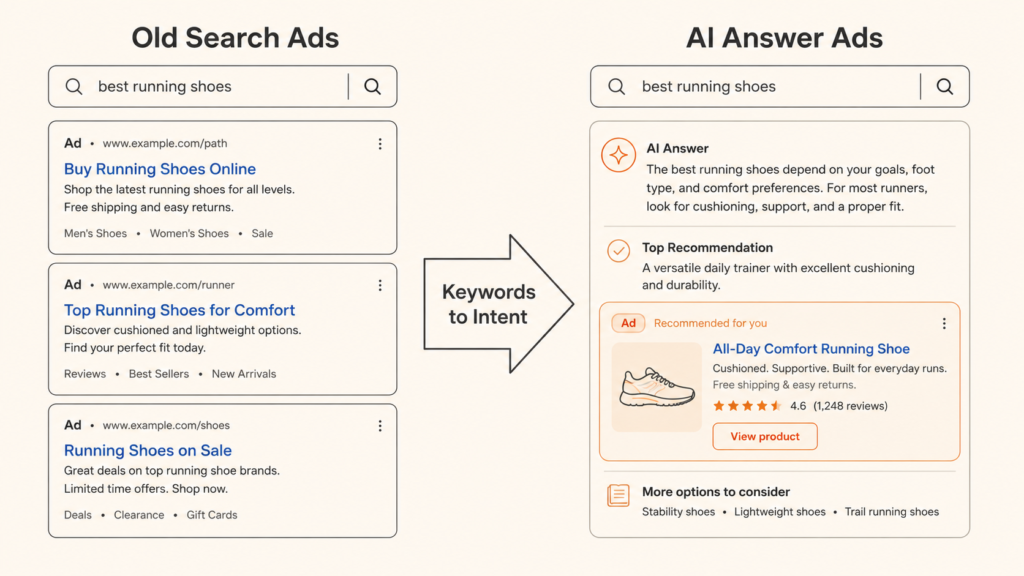
But now Google is changing the place where ads appear and the way those ads are created. With AI becoming part of Search, ads are no longer limited to blue links, headlines, and descriptions. Google is slowly moving ads inside AI-generated answers.

That may sound like a small product update, but for marketers, this is a major shift.

Because if the user’s decision is happening inside the AI answer, then the ad also needs to live inside that answer.

Why Google Is Changing Search Ads?

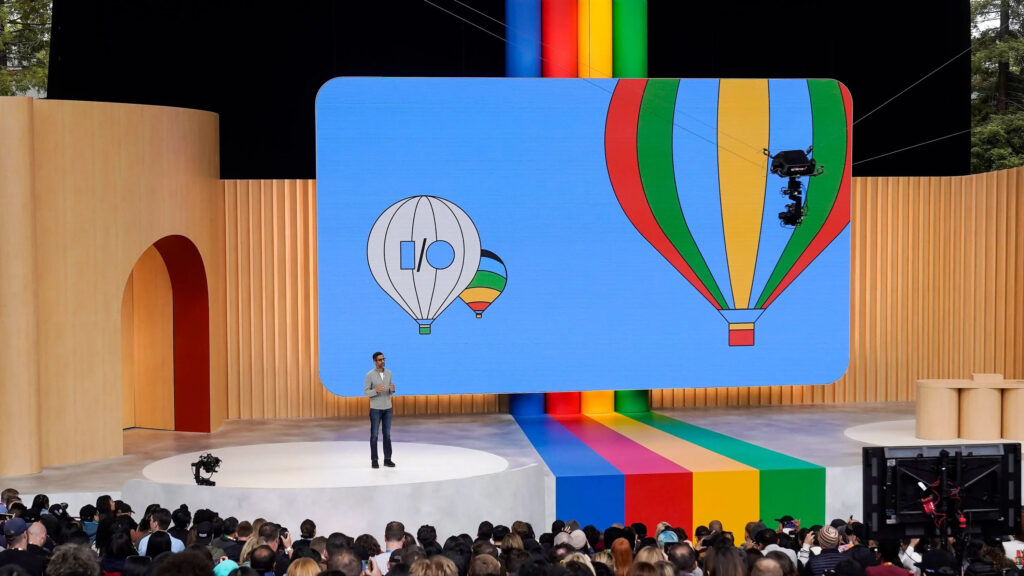
At Google Marketing Live, Google introduced new AI-powered ad experiences built around Gemini. These updates show how Google wants paid search to work in an AI-first search experience.

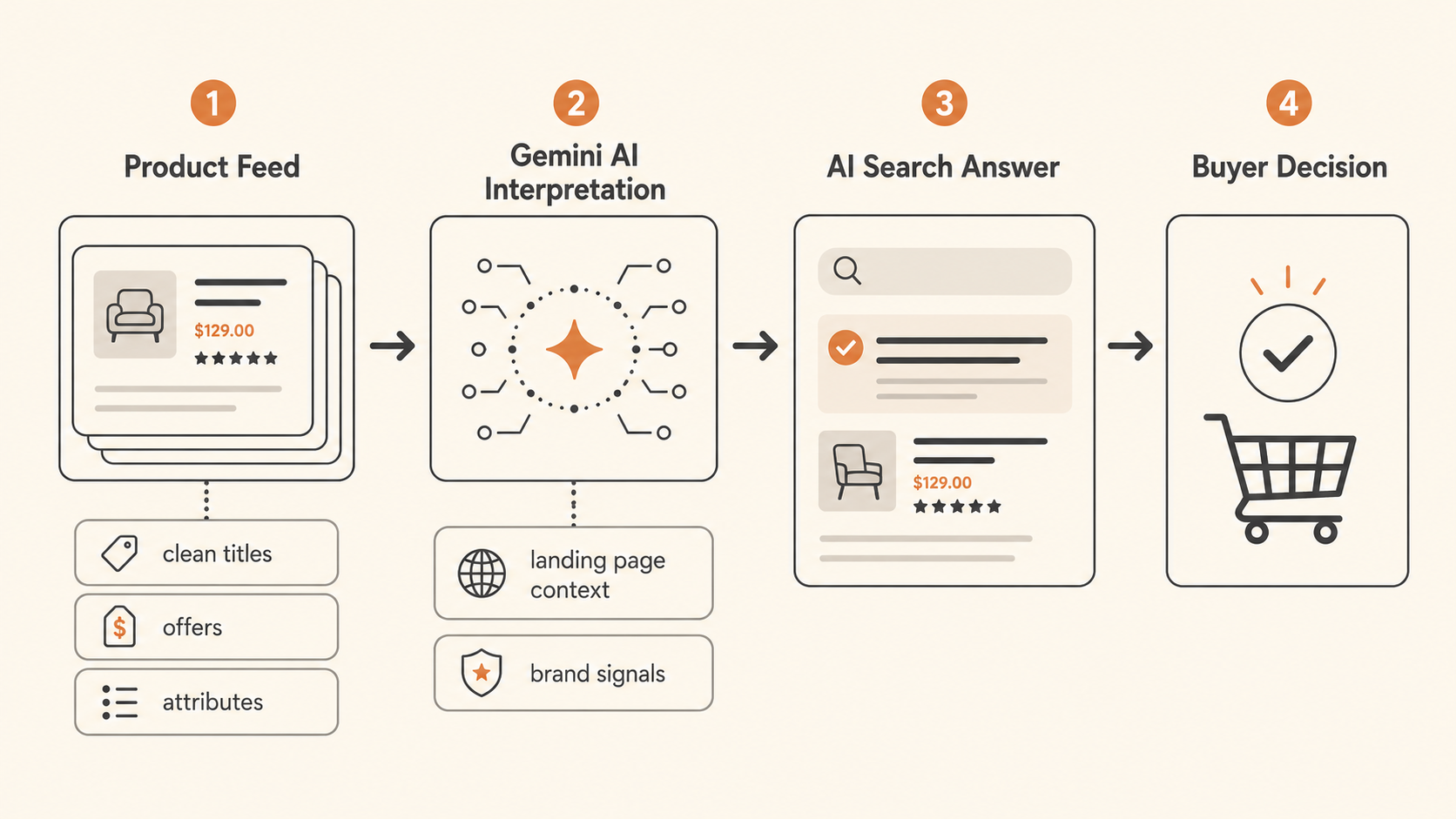
Instead of only showing a traditional search ad with a fixed headline, Gemini can understand the user’s query, interpret the intent, and help generate more relevant ad responses. This means the ad may feel less like a separate ad unit and more like part of the answer experience.

That changes the role of the advertiser.

Earlier, advertisers mainly focused on writing better headlines, stronger descriptions, and cleaner landing pages. Those things still matter, but they may not be enough anymore.

Now, Google’s AI needs the right product data, business information, offers, feed quality, landing page context, and brand signals to create a useful ad response.

In simple words, Google is not just asking advertisers to write better ads.

It is asking them to feed the machine better information.

The Product Feed Is Becoming More Important

This is where many advertisers may struggle.

If AI is going to build or shape ad responses, it needs strong raw material. That raw material comes from product feeds, Merchant Center data, business profiles, website content, campaign assets, and structured information.

A clean product feed can help AI understand what the brand sells, who the product is for, what makes it different, and when it should appear.

A weak product feed does the opposite.

If product titles are messy, attributes are missing, images are poor, pricing is unclear, or offers are not updated, then the AI has less useful information to work with.

That creates a bigger gap between well-managed accounts and neglected accounts.

This is not only a technical issue. It is a marketing strategy issue.

Because in an AI-powered ad system, the brand with better data may get better visibility, better relevance, and better conversion opportunities.

The New Job of the Marketer

This shift changes what performance marketers need to focus on.

Earlier, a lot of search advertising work was about keywords, match types, bids, ad copy, and landing pages. Those are still part of the system, but AI is pushing marketers toward a different type of work.

The new job is to make sure the AI understands the business correctly.

That means marketers need to think about:

What information are we giving Google?

Is our product feed clean?

Are our offers clear?

Is our landing page explaining the product properly?

Are our assets strong enough for AI to use?

Are we giving the system the right guardrails?

This is where marketing analytics and campaign structure become more important. If the data going into the system is weak, the output will also be weak.

AI does not magically fix poor inputs.

It usually exposes them.

Why Advertisers Are Nervous

Advertisers are nervous because this shift gives Google more control over how ads are shown and explained.

In the old model, the advertiser had more direct control over the headline, description, keyword targeting, and landing page message.

In the new AI-driven model, Google may play a larger role in interpreting the query and shaping the ad response.

That creates a trust issue.

Advertisers will want to know:

Is the AI explaining my product correctly?

Is it making claims I did not approve?

Is it showing my offer in the right context?

Is it prioritizing Google’s automation over my brand strategy?

Is performance improving because of better relevance, or because we are giving up more control?

These are not small questions.

When AI becomes part of ad delivery, the advertiser is not only buying media. They are also trusting the platform to represent the brand correctly.

That is why this update matters.

Meta’s Growth Adds More Pressure

The bigger story is not only about Google.

Meta is also growing fast in advertising, and forecasts suggest Meta could overtake Google in digital ad revenue. That shows how much the advertising market is shifting.

For years, Google was the default anchor for many ad budgets because search captured high-intent users. If someone searched for a product or service, they were already close to making a decision.

But Meta has become stronger at using AI to find buyers before they search.

That creates a different type of competition.

Google is trying to protect the decision moment inside Search.

Meta is trying to influence the buyer before that moment happens.

That is why Google moving ads into AI answers makes sense. If the search experience is becoming conversational, Google cannot let ads remain stuck in the old search format.

The ad has to move closer to the answer.

What Brands Should Do Now

Brands should not panic, but they should not ignore this either.

The first step is to audit the quality of their data.

Product feeds, landing pages, creative assets, business descriptions, pricing, inventory, and offers need to be accurate and complete. If Google’s AI is going to use this information to create or support ad experiences, then messy data becomes a direct performance problem.

The second step is to think beyond ad copy.

The future of search ads may not be about who writes the cleverest headline. It may be about who gives the AI the clearest product information, strongest proof points, and most useful business context.

The third step is to monitor how AI-powered ad experiences represent the brand.

If AI is generating explanations, advertisers need to review whether those explanations match the brand’s positioning, offer, and customer promise.

This is where marketers need both creativity and control.

AI can help scale advertising, but brands still need to decide what they want to be known for.

Representation

My Perspective

As someone interested in marketing analytics and performance marketing, I think this shift is bigger than a normal Google Ads update.

It shows that paid search is moving from keyword targeting to intent interpretation.

That means marketers cannot only think about campaigns at the ad level. They need to think about the entire information system behind the campaign.

The feed matters.

The landing page matters.

The product data matters.

The brand positioning matters.

The campaign structure matters.

The quality of measurement matters.

AI may create faster ad experiences, but it still depends on the strength of the inputs. If the business gives weak information, the AI will not magically create a strong strategy.

This is also where smaller brands need to be careful. Large brands may have cleaner feeds, better assets, stronger websites, and more historical data. Smaller brands may fall behind if they treat AI ads like a plug-and-play feature.

The marketers who win in this new environment will not be the ones who simply “turn on AI.”

They will be the ones who know how to prepare the data, guide the system, and judge whether the output actually supports the business goal.

Final Takeaway

Google moving search ads into AI answers is not just a format change.

It changes the relationship between search, ads, and decision-making.

The user may no longer move from search query to ad to website in the same old way. The decision may start inside an AI-generated answer, where the platform explains, recommends, compares, and guides the user.

That means advertisers need to rethink what visibility means.

Being present in search may no longer be enough.

Brands need to be understood correctly by the AI layer.

They need clean data, clear offers, strong product information, and better control over how their business is represented.

Search advertising is not disappearing.

But the old version of search ads is being rebuilt.

And for marketers, the next competitive advantage may not be writing the best ad headline.

It may be feeding the AI the best possible version of your business.

Reader Question:

If Google’s AI starts shaping how ads are written, explained, and placed inside search answers, will advertisers gain better performance  or lose too much control over their brand message?

When AI Search Gets It Wrong: Why Google’s AI Overview Is Now a Brand-Safety Risk

Court Representation

AI Search Is No Longer Neutral: What Brands Should Learn from Google’s Court Case

AI Search Is Now a Brand-Safety Problem, Not Just an SEO Problem

For years, brands worried about what people said about them on Google.

Bad reviews. Negative articles. Reddit threads. Competitor comparisons. Old complaints that kept ranking.

But now the problem is changing.

It is no longer only about what websites say about your brand. It is also about what Google’s AI says after reading those websites, summarizing them, and presenting the answer directly to users.

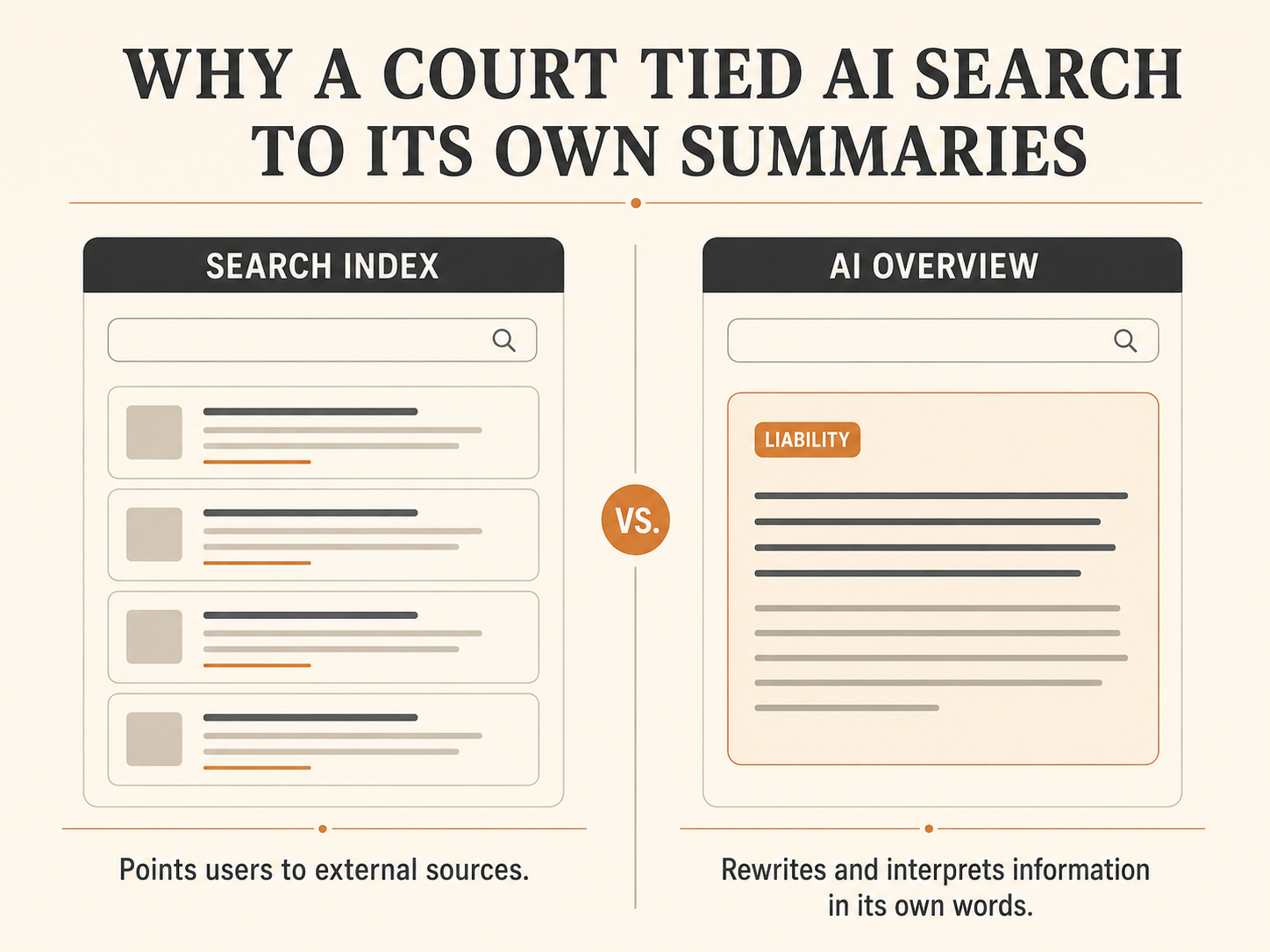
That shift matters because AI search does not behave like traditional search. A normal Google result points users toward a list of sources. An AI Overview does something more powerful. It reads, rewrites, summarizes, and gives users a direct answer in Google’s own interface.

That sounds useful when the answer is accurate.

But when the answer is wrong, it becomes a brand reputation problem.


Graphical representation

A recent court decision in Germany shows why this matters.

A German Court Just Sent a Warning to AI Search Platforms

A regional court in Munich reportedly ruled that Google can be held responsible when its AI Overview makes false claims about a brand.

The issue involved two Munich publishing companies. Google’s AI Overview had connected them to scams and “subscription traps,” even though the cited sources did not support those claims.

That detail is important.

The problem was not simply that Google showed a bad search result. The problem was that Google’s AI layer created a summary that appeared to make its own judgment. It did not just send users to another website. It interpreted the information and presented the result as an answer.

That is where the legal and marketing issue begins.

Traditional search has always been built around links. Google could say it was indexing the web and helping users find information. But AI Overviews work differently. They do not only index information. They convert information into a finished response.

For brands, that changes the risk.

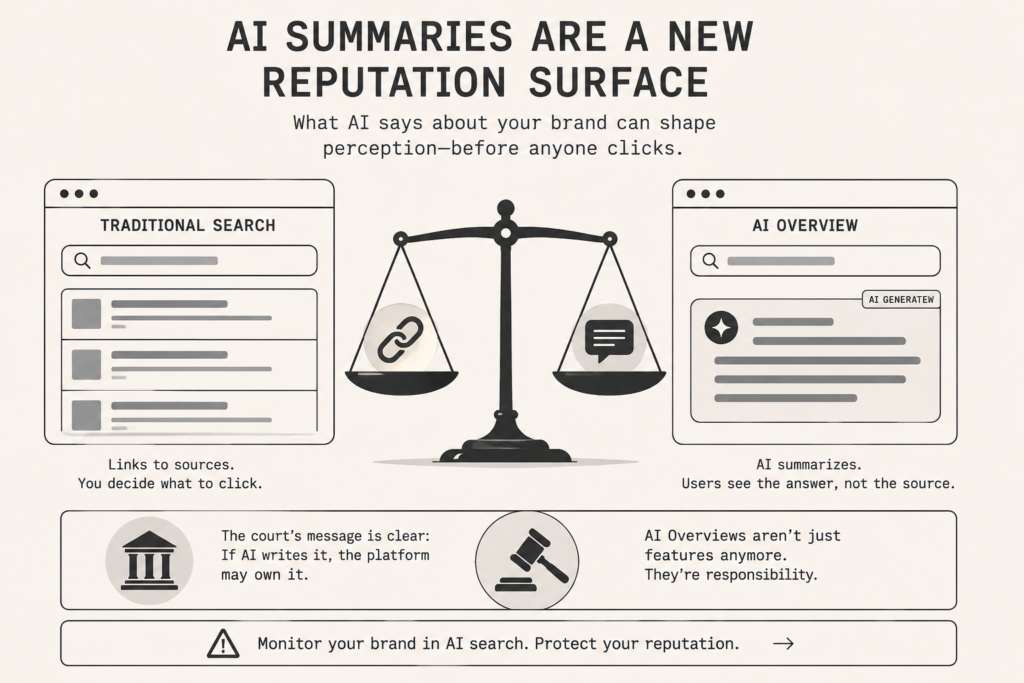
If an AI summary says something false about your business, many users may never click through to check the original sources. They may simply trust the answer because it appears directly inside Google.

That makes the AI summary itself a new reputation surface.

Why This Is Bigger Than a Legal Story

At first, this might look like a legal case about one court, one country, and one AI Overview.

But the bigger lesson is about how brand visibility is changing.

In the old search world, brands mainly cared about rankings. If your website ranked well, you had visibility. If negative content ranked above you, you had a reputation problem. If your competitors outranked you, you had an SEO problem.

Now, ranking is only part of the story.

AI search creates another layer between the user and the web. That layer decides what to summarize, what to ignore, what to connect, and what to present as the final answer.

That means brands are no longer competing only for search rankings. They are competing for how AI systems understand them.

This is a major shift for marketers.

A brand could have strong SEO, good website content, and positive press coverage, but still be misrepresented by an AI-generated summary. The user may never see the full source. They may only see the AI answer.

That creates a new question for every business:

What does AI believe about your brand?

AI Overviews Are Becoming a Reputation Surface

Every brand already has reputation surfaces.

Your website is one.

Your Google Business Profile is one.

Your reviews are one.

Your social media presence is one.

Your Reddit mentions, press articles, YouTube videos, and third-party listings are all part of the public picture.

Now AI Overviews need to be added to that list.

The difference is that brands cannot directly edit AI Overviews the way they can edit their website or Google Business Profile. The AI summary is generated from a mix of sources, signals, and context that the brand does not fully control.

That makes it harder to manage.

If your website has outdated information, you can update it.

If your landing page has weak copy, you can rewrite it.

If your ad campaign has poor messaging, you can pause it.

But if an AI Overview creates a false or misleading summary, the path to fixing it is less clear.

That is why this court decision matters. It suggests that when AI search platforms generate their own summaries, they may also carry responsibility for what those summaries say.

For brands, that creates both a risk and a possible protection.

Why Marketers Should Care

This is not only a legal issue. It is a marketing operations issue.

Marketers already monitor rankings, traffic, conversions, reviews, social mentions, and campaign performance. AI search monitoring may now need to become part of that same system.

If your brand appears in AI Overviews, you need to know what is being said.

Search your brand name.

Search your brand name with words like scam, lawsuit, complaints, pricing, refund, reviews, problems, and alternatives.

Do the same for your top products, services, executives, and competitors.

This is not paranoia. It is reputation hygiene.

The danger is not only that AI gets something wrong. The danger is that the wrong answer appears confident, polished, and official enough for users to believe it.

That is what makes AI-generated misinformation more serious than a random bad comment online.

A bad comment looks like a comment.

A bad AI summary can look like an answer.

The New Brand-Safety Checklist

Brands should start treating AI search as part of brand safety.

That means creating a simple monitoring process.

First, check how your brand appears in AI Overviews.

Second, document anything false, misleading, or unsupported.

Third, take screenshots with dates.

Fourth, compare the AI answer with the sources it claims to use.

Fifth, update your own website content if your public information is unclear, incomplete, or outdated.

Sixth, build stronger third-party signals through credible articles, profiles, case studies, and structured content.

This does not mean every company needs a massive AI search team. But it does mean companies need a habit.

The brands that ignore this will find out late.

The brands that monitor early will understand how AI systems are interpreting them before it becomes a larger reputation issue.


My Perspective:

From a marketing analytics and performance marketing perspective, this case shows that visibility is no longer just about clicks.

For a long time, marketers measured search mainly through rankings, impressions, CTR, and organic traffic. Those metrics still matter, but they do not fully explain what is happening in AI search.

If a user reads an AI Overview and never clicks, the brand may still be influenced positively or negatively.

That means the impact happens before the website visit.

This is where traditional analytics becomes weaker. GA4 may show fewer visits. Search Console may show impressions and clicks. But neither tool fully explains how AI summaries are shaping perception before the click.

That is why marketers need to think beyond traffic.

The question is not only, “Did the user visit our site?”

The better question is, “What did the user learn about us before deciding whether to click?”

That is the new search reality.

Final Takeaway:

The German court case is a signal of where AI search is heading.

AI Overviews are not just search features. They are becoming public-facing brand narratives. They summarize companies, judge context, and influence what users believe.

For brands, this creates a new responsibility: monitor how AI describes you.

For platforms, it creates a new pressure: if the AI writes the answer, the platform may not be able to hide behind the idea that it only showed users a link.

Search is no longer just about being found.

It is about being understood correctly.

And in an AI-driven search world, that may become one of the biggest brand-safety challenges marketers have to manage.

Reader Question:

If Google’s AI gives a false summary about a brand, who should be responsible  the platform, the original sources, or the brand for not monitoring it early enough?

Reclaiming Your Time: Transforming Business Ownership into Freedom

freedom and empowerment in business

Reclaiming Your Time: Transforming Business Ownership into Freedom

In the fast-paced world of business, many entrepreneurs find themselves ensnared in the very operations they sought to control. What began as a passion project or a promising venture can swiftly morph into a burdensome obligation. This phenomenon often leads to a reality where business owners are trapped in endless meetings and decision-making processes, feeling overwhelmed and overextended. The key to breaking free from this cycle lies in understanding the structural issues that underpin business operations and employing strategic frameworks that prioritize efficiency and delegation.


As the digital landscape continues to evolve, the importance of regaining control over one’s time has never been more critical. With new tools and methodologies emerging, businesses can streamline workflows and delegate responsibilities without compromising quality or accountability. This blog will explore how implementing a structured approach can not only enhance operational efficiency but also pave the way for sustainable business growth.

The Cost of Overextension: Understanding the Ownership Trap

business owner overwhelmed

When entrepreneurs take on the full weight of their businesses, they often face a paradox: the more they try to manage every aspect of their operations, the less effective they become. This ownership trap manifests in various forms, from micromanagement to burnout, negatively impacting productivity and morale. It’s essential to recognize that this is not merely a capacity issue; it is fundamentally a structural problem within the organization.


For instance, many business owners find themselves bogged down by day-to-day operations, unable to focus on strategic growth initiatives. This situation leads to a lack of innovation and responsiveness to market changes, which can jeopardize the company’s long-term viability. By acknowledging this trap, entrepreneurs can begin to reassess their roles and the systems in place that dictate their daily activities.


Practical marketing interpretation: Marketers must understand that their productivity is directly linked to their ability to delegate effectively. By creating a structure that allows for the distribution of responsibilities, businesses can not only alleviate pressure on individual leaders but also foster a more agile and responsive organization.

Implementing the Freedom Framework: A Path to Empowerment

To escape the ownership trap, businesses can benefit from adopting frameworks designed to rebuild workflows and promote delegation. One such approach is the Freedom Framework, which emphasizes the importance of restructuring tasks and responsibilities. This framework encourages business leaders to identify bottlenecks and inefficiencies in their current workflows and implement solutions that facilitate smoother operations.

The Freedom Framework advocates for a shift in mindset, from one that prioritizes control to one that embraces empowerment. By involving team members in decision-making processes and granting them ownership over their tasks, leaders can cultivate a culture of accountability and trust. This not only enhances employee engagement but also leads to improved performance outcomes.

For example, by leveraging virtual assistants or specialized teams, businesses can offload routine tasks and focus on strategic initiatives. This shift allows leaders to step back and concentrate on growth opportunities, ultimately driving the business forward.

Practical marketing interpretation: Marketers should view the Freedom Framework as a tool for enhancing collaboration and creativity within their teams. By fostering an environment where everyone is encouraged to contribute ideas and solutions, businesses can unlock new avenues for growth and innovation.

Harnessing Technology: The Role of AI in Streamlining Operations

AI tools are actively assisting a team

The rise of artificial intelligence (AI) offers businesses unprecedented opportunities to automate repetitive tasks and streamline processes. However, many companies still rely on outdated methods and fail to leverage technology to its fullest potential. Embracing AI not only enhances operational efficiency but also allows business leaders to focus on strategic planning and creative problem-solving.

For instance, Google’s AI Max feature is a prime example of how technology can be utilized to optimize advertising campaigns. By leveraging AI to analyze data and target audiences more effectively, marketers can enhance their campaign performance while minimizing manual effort. This shift toward automation empowers teams to innovate and adapt quickly to changing market conditions.

Incorporating AI into business operations is not just about increasing efficiency; it’s also about rethinking the entire approach to marketing and customer engagement. Businesses that successfully integrate AI into their workflows can provide more personalized experiences for their customers, ultimately driving growth and retention.

Practical marketing interpretation: Marketers should prioritize investing in AI tools that align with their business objectives. By doing so, they can not only enhance their operational capabilities but also position themselves as leaders in delivering superior customer experiences.

The Importance of Structure: Building a Resilient Business Model

well-organized business structure

A strong business structure is vital for fostering resilience and adaptability in an ever-changing marketplace. Organizations that prioritize clear roles, responsibilities, and processes are better equipped to navigate challenges and seize opportunities. By creating a resilient business model, companies can withstand market fluctuations and maintain a steady trajectory toward growth.

Establishing a clear hierarchy and defined workflows helps prevent confusion and overlaps in responsibilities. This clarity not only enhances accountability but also empowers employees to take ownership of their roles. When everyone knows their responsibilities and how they contribute to the larger goals of the organization, it creates a cohesive working environment that drives performance.

Moreover, a well-structured business model allows for scalability. As companies grow, having established processes in place makes it easier to onboard new team members and expand operations without losing efficiency. This adaptability is crucial for long-term success in today’s competitive landscape.

Practical marketing interpretation: Marketers must advocate for organizational structures that support agility and collaboration. By promoting a clear framework for teamwork, businesses can ensure that their marketing efforts are aligned with their overall strategic goals.

Conclusion: Embracing Change for Sustainable Growth

In a world where business landscapes are constantly shifting, the ability to adapt and evolve is paramount. By recognizing the ownership trap and implementing frameworks that promote delegation and accountability, entrepreneurs can reclaim their time and focus on what truly matters driving growth and innovation.

As businesses embrace technology and establish robust structures, they position themselves for long-term success. The journey to reclaiming ownership over one’s time may require initial effort and investment, but the rewards enhanced productivity, improved morale, and sustainable growth  are well worth it.

MY PERSPECTIVE:

From my standpoint in marketing analytics and performance marketing, it is clear that businesses must prioritize strategic frameworks and technological integration to thrive in today’s environment. The lessons learned from the ownership trap resonate deeply with me, as I have witnessed firsthand the transformative power of delegation and structure in driving business success.

Marketers, agencies, and businesses should take these insights to heart. By fostering a culture that emphasizes trust and empowerment, organizations can unlock their full potential. It’s not just about working harder but working smarter and that begins with a commitment to change.


FINAL TAKEAWAY:

Ultimately, the key takeaway from this discussion is the importance of stepping back to reevaluate how we operate within our businesses. By understanding the structural issues at play and implementing effective frameworks, entrepreneurs can transform their roles from being operationally tethered to strategically empowered.

As we move forward in this digital age, let us embrace change and leverage the tools available to us, freeing ourselves to focus on what we do best growing our businesses and creating meaningful impact.

What strategies have you implemented in your business to regain control over your time and improve operational efficiency?

Maximize Efficiency: How One AI Tool Can Replace Your Marketing Stack

clarity vs complexity

Maximize Efficiency: How One AI Tool Can Replace Your Marketing Stack

In the fast-paced world of e-commerce, efficiency is not just a luxury; it’s a necessity. Many sellers find themselves juggling several tools, each fulfilling a specific need, but collectively adding to their workload and expenses. With the advent of advanced AI technologies, there’s a transformative opportunity for businesses to streamline operations and reduce costs. This blog explores how an all-in-one AI solution can take over the functions of multiple tools, enhancing efficiency and profitability for e-commerce sellers.

The current landscape of digital marketing requires businesses to be agile and responsive. As competition intensifies, the need for a robust strategy that integrates various functions market analysis, listing optimization, and performance tracking is crucial. Enter StoreClaw, a pioneering AI engine that promises not just to simplify operations, but to empower sellers with the insights and automation they need to thrive in a competitive marketplace.

By leveraging AI, businesses can not only save on costs but also gain a significant advantage in performance marketing. In this blog, we’ll delve into the core benefits of utilizing a single AI platform and why now is the perfect time to embrace this change.


The Challenge of Multiple Tools in E-Commerce

Managing an e-commerce store often involves using multiple tools for different tasks market research, SEO optimization, social media marketing, inventory management, and more. Each tool comes with its own learning curve, subscription costs, and maintenance challenges. This fragmentation can lead to inefficiencies and missed opportunities. For instance, a seller might spend hours compiling data from various platforms, only to find that the insights they gather are outdated or incomplete.

Moreover, the cost of maintaining multiple subscriptions can add up quickly, often running into hundreds of dollars each month. This financial burden can be particularly detrimental for small businesses and startups that are already operating on tight margins. The complexity of managing several tools can also hinder agility, making it difficult for sellers to respond swiftly to market changes or consumer demands.

Adopting an all-in-one AI solution like StoreClaw addresses these challenges head-on. By consolidating multiple functionalities into a single platform, e-commerce sellers can streamline their operations, reduce costs, and free up valuable time to focus on strategic growth.

.

The Power of Automation in Marketing

Automation

One of the most compelling benefits of using a unified AI tool is the automation of repetitive tasks. StoreClaw operates continuously in the background, monitoring competitors, optimizing product listings, and automating marketing campaigns without the seller needing to intervene constantly. This level of automation not only saves time but also ensures that critical marketing tasks are executed consistently and accurately.

For example, imagine having an AI that automatically adjusts your product listings based on competitor analysis and market trends. Instead of manually researching and updating listings, the AI does this in real time, ensuring that your products are always competitively positioned. This proactive approach can significantly enhance visibility and sales.

Furthermore, automation allows for data-driven decision-making. With StoreClaw’s analytics, sellers can receive instant insights into their performance metrics, allowing them to adjust strategies promptly. This capability is crucial in a rapidly changing market, where agility can mean the difference between success and failure.

Enhancing Data-Driven Decisions with AI Insights

data driven dashboard

In today’s marketing landscape, data is king. However, the challenge lies in effectively analyzing and utilizing that data. StoreClaw provides comprehensive analytics that empower sellers to make informed decisions. By integrating data from various sources, the AI generates actionable insights that help in understanding consumer behavior, market trends, and overall performance.

For instance, the AI can highlight which products are underperforming and suggest optimizations or promotional strategies to boost their visibility. Additionally, it can analyze customer interactions and feedback, allowing for tailored marketing strategies that resonate more deeply with target audiences.

This depth of insight is often unattainable with traditional tools that operate in isolation. By harnessing the collective power of data, sellers can refine their strategies, enhance customer engagement, and ultimately drive growth.

.

Cost Efficiency and Scalability

One of the primary concerns for e-commerce sellers is cost efficiency. As mentioned earlier, relying on multiple tools can quickly lead to rising expenses. StoreClaw eliminates the need for several subscriptions, allowing businesses to save money while still accessing a broad range of functionalities. This is particularly advantageous for startups and smaller businesses, where every dollar counts.

Moreover, as your business grows, the AI’s scalability becomes a significant advantage. Unlike traditional tools that may require additional fees or new subscriptions as you expand, StoreClaw can adapt seamlessly to your increasing needs. This means that as your e-commerce operations grow whether you’re adding new products, entering new markets, or increasing your marketing efforts you can do so without the hassle of managing multiple platforms.

The combination of cost savings and scalability not only enhances profitability but also provides a solid foundation for sustained business growth.

Real-World Applications and Success Stories

While the theoretical benefits of an all-in-one AI solution are compelling, real-world applications underscore its effectiveness. Numerous e-commerce businesses have reported significant improvements in their operational efficiency and profitability after switching to a single AI platform.

For example, businesses that have integrated StoreClaw have found that their time spent on marketing tasks has decreased by over 50%. This efficiency has allowed them to focus on expanding their product lines and enhancing customer service. Additionally, these businesses have noted a marked increase in sales due to better-optimized listings and proactive marketing campaigns.

Furthermore, the ability to quickly adapt to market changes, thanks to AI-driven insights, has become a game-changer for many sellers. By staying ahead of trends and adjusting strategies in real-time, businesses are not only surviving but thriving in a competitive landscape.

MY PERSPECTIVE:

As someone deeply entrenched in marketing analytics and performance marketing, I’ve witnessed firsthand the transformative power of AI in the e-commerce sector. The shift towards an all-in-one AI solution is not just a trend; it’s a strategic movement that can redefine how businesses operate. Marketers, agencies, and brands must embrace this change to remain competitive.

The ability to automate tasks, glean actionable insights, and operate cost-effectively is essential in today’s digital marketplace. I encourage marketers to evaluate their current toolsets critically. Are they overpaying for functionalities that could be seamlessly integrated into a single platform? The future of marketing lies in leveraging technology to drive efficiency and growth.

FINAL TAKEAWAYIn conclusion, the rise of AI solutions like StoreClaw signifies a pivotal moment for e-commerce sellers. By consolidating various marketing tools into one autonomous engine, businesses can enhance their efficiency, reduce costs, and empower data-driven decision-making. As the market continues to evolve, those who leverage AI effectively will not only survive but thrive.

Now is the time to assess your current marketing strategies and consider how an all-in-one AI tool can revolutionize your approach. Embracing this technology is not just about keeping pace with competitors; it’s about leading the charge towards a more efficient and profitable future.


The Rise and Fall of MoviePass: Lessons for Marketers

Movie pass

The Rise and Fall of MoviePass: Lessons for Marketers

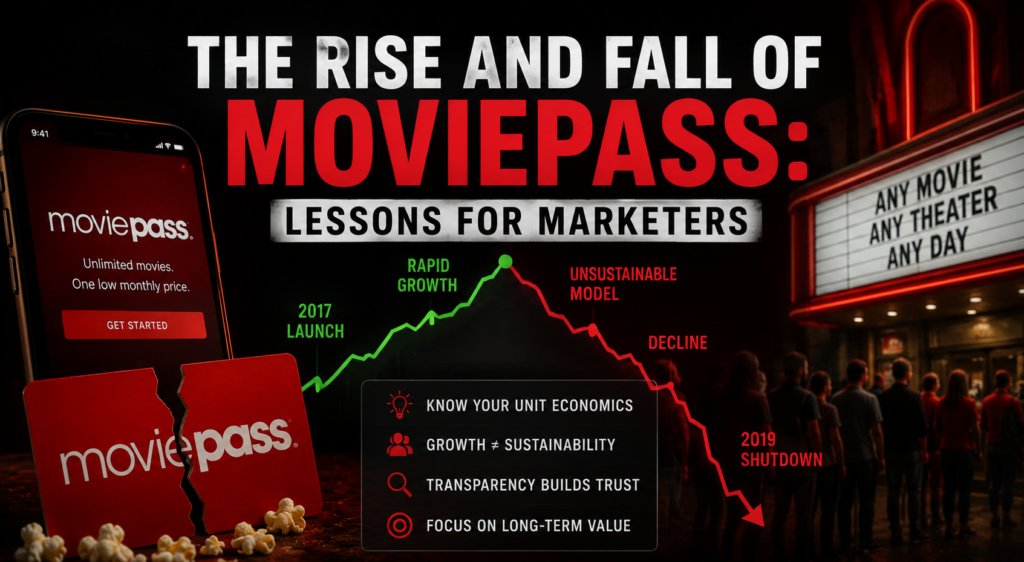
In the ever-evolving landscape of marketing, the story of MoviePass stands as a cautionary tale. Launched in 2017, MoviePass offered an irresistible deal: one movie ticket per day for just $9.95 a month. This groundbreaking offer created a massive wave of subscriptions, attracting over two million users within six months. However, this meteoric rise was followed by an equally dramatic fall, leading to the company’s collapse in 2019. Understanding the missteps of MoviePass is crucial for marketers today, especially as businesses navigate the challenges posed by disruptive pricing strategies and customer expectations.

 The MoviePass saga is not merely about a failed business; it encapsulates vital lessons about aligning marketing promises with business realities. As we delve deeper into this case, we will uncover the key marketing mistakes made by MoviePass and how modern marketers can avoid similar pitfalls.

Rise and fall of movie pass

The Allure of an Irresistible Offer

The first major takeaway from the MoviePass experience is the power of an irresistible offer. The company’s $9.95 subscription was not just a price point; it was a marketing phenomenon that generated buzz and viral word-of-mouth. It was so compelling that it required little traditional advertising subscribers did the marketing for MoviePass by sharing their excitement on social media and news outlets.

 However, this success also highlighted a significant flaw: the offer was unsustainable. MoviePass paid theaters the full ticket price, leading to massive losses with every transaction. Marketers must recognize that while attractive offers can drive customer acquisition, they must be backed by a feasible business model. A marketing strategy must consider not only how to attract customers but also how to retain profitability.

The Dangers of Adverse Selection

One of the critical miscalculations by MoviePass was its assumption about customer behavior. The company believed that most subscribers would be light users, taking advantage of the subscription only a few times a year. In reality, the offer attracted avid moviegoers who utilized the service frequently, leading to higher operational costs than anticipated. This phenomenon, known as adverse selection, occurs when an offer disproportionately attracts customers who are more costly to serve.

For contemporary marketers, this illustrates the importance of understanding customer segments and their behaviors. When designing offers, it’s essential to conduct thorough market research to anticipate how different customer groups will respond. Building customer personas can help businesses tailor their marketing strategies to attract the right customers, thereby avoiding adverse selection pitfalls.

The Consequences of Broken Promises

As financial pressures mounted, MoviePass began altering its service terms, imposing blackout dates and removing popular movies from its platform. These changes eroded consumer trust and loyalty, and the company’s once-strong brand image suffered immensely. When customers feel misled, the damage to brand reputation can be irreparable.

This scenario serves as a stark reminder for marketers: trust is an invaluable asset. Maintaining transparency with customers and delivering on promises is crucial. If companies must pivot or adjust their offerings due to unforeseen circumstances, clear communication is essential to preserve customer relationships. Brands that prioritize honesty and transparency are more likely to build lasting loyalty and mitigate the risk of backlash.

shake hands

Scaling Without a Sustainable Model

MoviePass’s ambition to scale rapidly ultimately contributed to its downfall. The company believed that by amassing a large user base, it could leverage data and negotiate better terms with theaters. However, it failed to establish a sustainable revenue model, which only multiplied its financial losses.


For marketers, this highlights the importance of aligning growth strategies with sustainable practices. When planning for scale, businesses should develop robust financial models that account for potential customer usage patterns and the costs associated with fulfilling customer demand. A well-thought-out growth strategy should focus not only on acquiring customers but also on ensuring that the business can effectively meet their needs without jeopardizing profitability.

Key Takeaways for Today's Marketers

The story of MoviePass is a rich source of lessons for modern marketers. First, while attractive offers can drive initial success, they must be sustainable. Second, understanding customer behavior is crucial to avoid adverse selection. Third, maintaining transparency is essential for building trust, especially when changes to service occur. Finally, scaling a business requires a sustainable model that aligns customer demand with operational capabilities.

raising

MY PERSPECTIVE:

As a professional focused on marketing analytics and brand strategy, the MoviePass case underscores the necessity of integrating marketing efforts with business realities. Marketers need to leverage data to understand their customer base deeply, ensuring that their strategies align with not only customer desires but also the financial health of the business. Implementing rigorous analytics will help in modeling scenarios that predict customer behavior and the impact of offers on profitability.

What lessons have you learned from marketing campaigns that didn’t go as planned?

Harnessing AI for Marketing Success: Lessons from the Latest Innovations

AI in marketing

In the rapidly evolving landscape of marketing, the integration of artificial intelligence (AI) is reshaping strategies and redefining success metrics for brands. With major industry events like Google I/O and Google Marketing Live on the horizon, marketers are keenly aware that the next few days could fundamentally alter how AI is leveraged in search and advertising. The excitement surrounding these updates underscores the importance of adapting to technological advancements that are not just novelties but essential tools for driving business growth.

As AI continues to permeate various facets of marketing, brands must navigate the complexities of implementation and optimization. The recent developments from key players such as Google and Netflix demonstrate that the future of advertising is not only about deploying AI tools but also about ensuring they work effectively within existing frameworks and provide tangible results. This blog will explore the implications of these innovations and how they can inform strategic marketing decisions moving forward.


Google’s anticipated announcements during its I/O event signify a potential shift in how brands approach search engine optimization (SEO) and online visibility. With updates expected around AI Mode in Search and new advertising products linked to Gemini and YouTube, marketers must be prepared to adapt their strategies. The introduction of AI-driven features may change the landscape of organic traffic, pushing brands to rethink their approach to content creation and search visibility.


For marketers, this means staying informed and agile. As AI becomes a default operating mode for search, brands that prioritize high-quality content and user experience will likely see better engagement and visibility. The implications extend beyond mere visibility; they signal a need for deeper consumer understanding and the ability to respond swiftly to changes in search algorithms and user behavior. Building a proactive content strategy that anticipates these changes will be crucial for maintaining a competitive edge.

Netflix is pioneering the use of AI agents to manage and optimize its advertising campaigns, marking a significant evolution in how media buying is approached. By leveraging AI to automate ad management, Netflix can enhance its ad offerings, ensuring that they are not just a means of revenue generation but also a tool for providing personalized viewer experiences. This shift highlights the growing necessity for marketers to embrace automation and AI analytics in their advertising strategies.


The adaptation of AI in ad management allows for real-time optimization based on viewer data, which can significantly improve ad performance. For marketers, this means rethinking how they design campaigns. Instead of static ad placements, there is an opportunity to create dynamic ads that adapt to viewer preferences and behaviors. The challenge lies in integrating these AI capabilities into existing marketing frameworks while ensuring that creative strategies remain at the forefront of campaign development.

Anthropic’s recent advancements in enterprise AI have positioned it as a key player in the marketing technology landscape, outpacing competitors like OpenAI. This shift in enterprise AI adoption reflects a broader trend where businesses are increasingly investing in AI to enhance operational efficiency and marketing effectiveness. The rapid growth of AI tools designed for enterprise use underscores the need for marketers to be adept in both technology and strategy.


The implications for marketers are profound. As enterprise AI solutions become more prevalent, the ability to integrate these tools into marketing workflows will define future success. Marketers must prioritize understanding how AI can streamline processes such as customer segmentation, predictive analytics, and content personalization. The focus should be on creating a synergistic relationship between technology and marketing strategies to drive business outcomes.

Learning from Domino’s Radical Marketing Strategy

Domino’s has become a case study in how transparency and technology can transform a brand’s image and drive growth. By openly addressing customer criticisms and involving them in the rebranding process, Domino’s not only repaired its reputation but also established a loyal customer base. The use of technology to enhance customer experience—through seamless ordering channels and a user-friendly loyalty program, demonstrates the importance of adaptability in marketing.


For marketers, the lessons from Domino’s are clear: embrace transparency, leverage technology, and create meaningful customer engagement. Brands that can identify weaknesses and proactively address them through innovative solutions will foster trust and loyalty. This approach not only improves customer relationships but also drives long-term growth by turning customers into advocates for the brand.

The Future of Marketing: Integrating AI for Sustainable Growth

As AI continues to evolve, its integration into marketing strategies will be essential for sustainable growth. The recent innovations from industry leaders illustrate that the future is not just about adopting new technologies but also about understanding their implications for consumer behavior and brand engagement. Marketers must cultivate a mindset that values data-driven decision-making and agility in the face of rapid technological change.


Additionally, brands should focus on building first-party data assets through innovative campaigns that tie engagement to loyalty programs. By creating pathways for consumers to become active participants in brand narratives, marketers can enhance customer lifetime value and create more robust relationships.

From my perspective as a marketing professional focused on analytics, performance marketing, and brand strategy, the integration of AI into marketing frameworks is not merely a trend; it is a necessity. Marketers, agencies, and businesses must prioritize understanding how to leverage these technologies to enhance decision-making and optimize performance. The lessons learned from recent innovations provide a roadmap for navigating this complex landscape, emphasizing the importance of agility, transparency, and customer-centric strategies. Every marketer should view AI as an ally in their quest for consumer insights and operational efficiency, ensuring that they are positioned to thrive in an increasingly competitive environment.

FINAL TAKEAWAY:

The convergence of AI and marketing is set to redefine the industry in profound ways. As demonstrated by the advancements from Google, Netflix, Anthropic, and Domino’s, the future of marketing lies in the ability to adapt to new technologies while maintaining a strong focus on consumer engagement and brand loyalty. Marketers who embrace these changes and integrate AI thoughtfully into their strategies will not only enhance their effectiveness but also establish themselves as leaders in the digital marketing landscape. The time to act is now; the future of marketing is upon us, and those who are prepared will reap the rewards.

How do you think AI will change the way brands engage with consumers in the next few years?

Mastering Hyperparameters: Tuning Your Models for Business Impact!

person viewing screen

Mastering Hyperparameters: Tuning Your Models for Business Impact

In machine learning, hyperparameters are the settings we choose before training a model think of them as the oven temperature and baking time in a recipe. Getting these “knobs” right can dramatically improve performance, while poor choices lead to slow learning or overfitting. In business analytics, well-tuned models can drive better forecasts, smarter customer segmentation, and optimized operations. This post distills key concepts around hyperparameters, explains three essential types, shares practical analogies, highlights automation tools, and points to resources for streamlined tuning.


What Are Hyperparameters and Why They Matter

Hyperparameters govern how a model learns from data. Unlike model parameters (e.g., neural network weights) learned during training, hyperparameters are set by data scientists in advance. They influence:

  • Learning behavior: How quickly or cautiously a model updates.

  • Model complexity: How flexible or constrained its form becomes.

  • Generalization: Its ability to perform well on unseen data.

In business contexts such as forecasting sales, predicting churn, or optimizing supply chains hyperparameter choices can mean the difference between actionable insights and misleading outputs. A poorly tuned model might underfit (missing important patterns) or overfit (capturing noise as if it were signal). Thoughtful tuning helps ensure robust, reliable predictions that align with real-world decision-making.


Three Core Hyperparameters Explained

  1. Learning Rate

    • What it does: In algorithms using gradient descent (e.g., neural networks, gradient boosting), the learning rate determines the step size when adjusting model parameters to reduce error.

    • Risks: Too large a rate can cause erratic updates that overshoot optimal solutions; too small slows training, possibly trapping the model in suboptimal states.

    • Business example: For a churn prediction neural network, an appropriate learning rate helps the model converge efficiently without jumping around, balancing speed and stability. Typical starting values range from 0.001 to 0.1, but experimentation (and often automated search) is needed to find the sweet spot.

  2. Max Depth

    • What it does: In tree-based methods (decision trees, random forests, gradient boosting), max depth caps how many splits a tree can make. This directly controls complexity.

    • Risks: A shallow tree may underfit, ignoring subtle patterns; an overly deep tree risks memorizing training data (overfitting), harming generalization.

    • Business example: When segmenting customers for targeted marketing, a depth set too low might overlook niche but valuable segments; set too high, the model might tailor segments so narrowly that they don’t generalize to future customers. Balancing depth (often between 3 and 10) helps maintain interpretability and predictive power.

  3. Regularization Strength

    • What it does: Applies a penalty to overly complex models. In linear models, terms like alpha (in Ridge/Lasso) or C (in SVMs) shrink coefficients toward simpler solutions.

    • Risks: Excessive regularization can underfit by oversimplifying; too little allows overly complex fits that capture noise.

    • Business example: For financial forecasting, strong regularization prevents the model from chasing random fluctuations in historical data, improving stability on future outcomes. In Lasso regression, a well-chosen alpha may zero out irrelevant features, aiding interpretability for stakeholders.


A Real-World Analogy

Consider teaching someone to ride a bike:

  • Learning rate is akin to how firmly you guide their balance each time they wobble too forceful and they fall; too timid and progress stalls.

  • Max depth resembles the amount of instruction at once overloading them with steps vs. oversimplifying guidance.

  • Regularization strength mirrors the use of training wheels too much reliance and they won’t learn balance; too little too soon and they risk crashes.

Just as finding the right balance helps the learner ride confidently, tuning hyperparameters steers ML models toward reliable performance.


Automating Hyperparameter Tuning

Manual grid search or random search can be time-consuming. Modern platforms offer automated optimization:

  • AWS SageMaker Automatic Model Tuning: Runs distributed hyperparameter searches using strategies like Bayesian optimization, freeing data teams from manual tweaking.

  • Google Vertex AI Vizier: Provides built-in support for hyperparameter tuning with various search algorithms.

  • Ray Tune: An open-source library enabling scalable hyperparameter search across frameworks, with early stopping and support for algorithms like Bayesian optimization or ASHA.

Automating searches lets teams focus on framing problems and interpreting results rather than manual parameter sweeps. In production settings for example, a logistics firm optimizing route models this speeds up experimentation and can lead to more effective configurations.


Emerging Trends in Tuning Techniques

  • Transfer-Based Tuning: Reusing hyperparameter insights from smaller models or related tasks to accelerate tuning for larger networks. Recent discussions highlight methods like μ-Param or μTransfer for neural nets, reducing compute costs.

  • Bayesian Optimization & Beyond: Compared to brute-force grid search, Bayesian methods (e.g., through libraries like KerasTuner or Optuna) intelligently explore parameter spaces, often finding better results in fewer trials.

  • Early Stopping & Multi-Fidelity Methods: Algorithms that allocate resources adaptively evaluating many configurations briefly and focusing on promising ones improve efficiency, especially when training models is expensive.

Staying current with these techniques helps analytics teams optimize resource use and model quality.


Practical Steps for Business Analysts

  1. Identify Key Hyperparameters: For your chosen algorithm, list the most influential settings (e.g., learning rate, tree depth, regularization).

  2. Set Reasonable Ranges: Based on prior experience or literature, define search boundaries (e.g., learning rate from 1e-4 to 1e-1).

  3. Leverage Automation: Use cloud or open-source tuning tools to run experiments, tracking metrics like validation loss or AUC.

  4. Monitor and Interpret: Examine results for patterns (e.g., too high learning rates leading to unstable losses). Validate top configurations on hold-out data.

  5. Document & Deploy: Record chosen hyperparameters, the tuning process, and performance outcomes. Integrate the tuned model into production pipelines with monitoring to detect drift over time.


Recommended Resources


Conclusion

Hyperparameter tuning is a pivotal step in crafting effective machine learning solutions for business. By understanding core settings like learning rate, max depth, and regularization strength and leveraging automation and advanced search methods teams can build models that generalize well and drive actionable insights. Start with clear problem framing, use reasonable search boundaries, and harness tools such as AWS SageMaker, Vertex AI, or Ray Tune to streamline experimentation. With the right tuning strategy, models become powerful assets in predicting trends, optimizing operations, and ultimately delivering business value.

The Psychology of “Holy Sh*t, That’s Huge”: Why Oversized Marketing Works

Person seeing big cup


Why Monumental Marketing Grabs the Mind

People instinctively notice things that deviate drastically from everyday scale. Encountering an object far larger or smaller than expected interrupts our automatic mental routines and sparks curiosity. This “cognitive disruption” compels attention in an era of constant distractions marketingmonk.so. In marketing, oversized installations exploit this effect: they break the visual pattern of daily life, creating a momentary pause that brands can leverage.


Built for the Share Economy

In today’s smartphone-driven world, physical spectacles double as content generators. A striking giant prop invites onlookers to grab their phones, snap photos or videos (often posing alongside for scale), and share on social platforms. Each post becomes free promotion, as users willingly amplify the stunt to their networks. For instance, IKEA’s colossal Frakta bag wrap in London drew visitors to photograph and post their experiences, multiplying reach far beyond paid advertising reutersconnect.com. Such installations transform the audience into voluntary brand advocates, generating authentic buzz.


Context Is King: Aligning Scale with Story

Not all supersized ideas resonate. The most impactful oversized activations resonate with existing brand narratives or emotional ties. Marks & Spencer’s large-scale Percy Pig sculpture atop a store leveraged nostalgia for a beloved icon, amplifying positive associations rather than feeling arbitrary spurcreative.co.uk. Similarly, any enlarged replica must reflect brand values or promise: an absurdly large product makes sense only if it underscores the intended message (e.g., abundance, comfort, playfulness). If scale feels unmoored from brand identity, the stunt risks appearing hollow.


Loud Over Subtle: A Necessary Shift?

Classic understated commercials or cryptic hints can be elegant, but in a landscape saturated by thousands of messages daily, subtlety often goes unnoticed. Oversized installations act like a megaphone: overt, unpretentious, and memorable. They declare plainly, for example, “We craft exceptional coffee here’s a giant cup to prove it.” In many contexts, this candid spectacle cuts through clutter more effectively than nuanced campaigns. Brands must decide when boldness serves their audience and objectives better than quiet sophistication.


One-Time Investment, Long-Term Echo

Creating a large-scale installation can require a hefty upfront outlay, yet the earned media often dwarfs what equivalent paid campaigns achieve. Each social share, article, and mention adds up to widespread exposure at no extra cost. For example, IKEA’s oversized bag installation likely surpassed numerous conventional ads in total reach and longevity. Such installations can become landmarks or talking points lasting well beyond the launch period. To gauge impact, brands can use social-listening tools to tally mentions and estimate the equivalent paid ad budget needed for similar impressions linkedin.com.


Avoiding the Copycat Trap

As more brands adopt supersized activations, novelty wanes. Simply enlarging a product loses efficacy if everyone does it. The future lies in deepening the experience: adding interactive elements, narrative layers, or surprise twists. For example, collaborations that allow visitors to engage inside or around the installation—rather than merely photograph it sustain interest. Monitoring early engagement metrics (foot traffic, shares per visitor, sentiment) helps determine whether to enhance or pivot the experience.


Lessons for Smaller Players

Big budgets aren’t essential to play with scale. Even modest brands can create “larger-than-life” moments that resonate. A local café might install a giant coffee cup prop near a busy pedestrian route, inviting selfies and social mentions, at a fraction of major brand costs. Key steps: ensure the concept fits brand personality and audience expectations; design for easy sharing (branded hashtags, simple interactive prompts); and measure outcomes via basic analytics (e.g., track footfall changes, hashtag usage, or short-term sales lift). When scale aligns with a delightful idea, even small activations can punch above their weight.


Evolving the Spectacle: Beyond Physical Size

As oversized props become commonplace, maintaining the “wow” factor demands innovation. Future directions include:

  • Interactive Layers: Integrating AR elements so visitors can scan the installation for digital experiences.

  • Temporal Pop-Ups: Short-lived monuments that appear unexpectedly and vanish, preserving novelty.

  • Gamified Urban Interactions: Turning public spaces into participatory playgrounds (e.g., scavenger hunts tied to installations).
    Brands piloting lightweight experiments can track engagement data (both on-site interactions and online shares) to refine their approach and keep wonder alive.


Measuring Earned Media Against Traditional Spend

To compare experiential buzz with conventional advertising:

  1. Quantify Mentions & Reach: Use social-listening platforms to count posts referencing the installation and estimate aggregate impressions via contributors’ follower counts.

  2. Estimate Equivalent Ad Value: Calculate the paid budget that would be required to reach a similar audience size and frequency.

  3. Assess Engagement Quality: Evaluate sentiment and depth of interactions (comments, shares), recognizing that authentic UGC often outperforms polished ads in credibility.

  4. Track Conversions: Incorporate trackable calls to action (e.g., unique promo codes, QR-driven landing pages) to measure direct outcomes.

  5. Long-Term Recall: When feasible, conduct informal surveys or brand-lift studies to gauge lasting awareness or affinity shifts.


Fostering Genuine Connections

Oversized stunts succeed when they evoke emotions wonder, nostalgia, delight rather than merely shock. Tapping into existing emotional bonds with brand icons or values amplifies impact. Social media then transforms these physical experiences into expansive organic campaigns, as users share moments that feel novel and enjoyable. Measuring the ripple effects from immediate shares to longer-term brand recall helps validate investment and guide future activations.


Concluding Thoughts: Wonder as Currency

In a world flooded by marketing messages, creating genuine moments of surprise and delight remains a powerful strategy. Oversized props aren’t about literal scale alone but about instilling a sense of wonder. Even without building a gigantic replica, brands can embrace this mindset: design experiences that disrupt routine, resonate emotionally, and invite sharing. When executed thoughtfully aligned with brand identity and measured against clear objectives these moments can deliver outsized returns in attention, engagement, and lasting memory.

References & Suggested Links:

The Art of the Tease: What Makes a Movie Trailer Truly Unforgettable?

movie posters


Have you ever walked out of the theater humming a tune from a trailer or found yourself replaying a teaser on YouTube long after the credits rolled? You’re not alone. Even in the age of endless streaming and social-media scrolls, a great trailer still wields serious marketing magic. In fact, sisters Monica and Evelyn Brady co-founders of the Golden Trailer Awards have spent the last 25 years celebrating the craft behind those two-minute mini-movies that convince us to open our wallets (or at least hit “Add to Watchlist”).

After interviewing the Bradys, veteran trailer editor Benedict Coulter, and digging into industry trends, I’ve distilled the key ingredients that turn a simple preview into an unskippable cinematic appetizer. Whether you’re a filmmaker, marketer, or just a die-hard movie buff, here’s what you need to know.


1. Keep It Tight, But Make It Count

Sweet spot: roughly 90 seconds to 2 minutes.
Today’s audiences have razor-short attention spans, so any teaser that creeps past the two-minute mark risks feeling long in the tooth. Compare that with the sprawling, voice-of-God promos of the 1970s (some ran six or seven minutes!), and it’s clear the pacing game has changed.

“If you go back and watch those ’70s trailers, you’re crawling out of your skin,” Monica Brady jokes.

Digital platforms do allow for extended cuts or “special looks,” but the first bite has to be snack-sized just enough to spark curiosity without giving the plot away.


2. Hook the Heart Before the Head

Think of a trailer as a first date: you’re not rattling off your life story, you’re creating intrigue. The Bradys swear by an emotional anchor one unforgettable image, line of dialogue, or needle-drop that makes viewers feel something immediately. That feeling sticks far longer than a bullet-point list of plot exposition.

  • For action flicks: A pulse-pounding stunt or perfectly timed beat drop.

  • For intimate indies: A lingering close-up, a whispered confession, a single relatable moment.

  • For horror: A slow visual reveal that leaves the real scare off-screen (our imaginations fill in the blanks).


3. Let the Music Do the Heavy Lifting

If trailers were cocktails, music would be the secret bitters that tie the whole flavor profile together. Evelyn Brady calls the auditory recall of a great track “marketing gold.” The first three notes of the right song can raise goosebumps faster than any explosion. Veteran producer Jerry Bruckheimer built entire campaigns around that principle just think of the Top Gun anthem and how it primes you for speed and sky-high adrenaline before Tom Cruise even removes his helmet.

Insider tip: Modern editors often experiment with slowed-down pop hits or moody orchestral covers. Familiar songs in unfamiliar arrangements create instant recognition plus fresh intrigue.


4. Upend Expectations (Just Enough)

Studios still rely on tried-and-true trailer “formulas” because news flash they work. But the trailers people gush about? Those often zig when everyone else zags.

“If seven trailers follow the same blueprint and one breaks the rules, guess which one you’ll remember?” Coulter says.

Maybe it’s a fake-out jump scare, an unexpected tonal shift, or a mid-teaser mic drop that reveals the real genre twist. The key is balancing risk with clarity; surprise us, but don’t confuse us.


5. Respect the Audience—Don’t Spoil the Payoff

Nothing torpedoes excitement faster than a preview that spills the movie’s third-act twist. While marketing departments sometimes demand “more plot, more plot,” top editors push back, arguing the movie’s best moments belong on the big screen, not in your feed.

Evelyn’s rule of thumb: If the entire story fits in two and a half minutes, maybe the feature itself needs another revision pass.


Why It Matters (Far Beyond the Box Office)

Trailers aren’t just ads they’re cultural touchpoints. An unforgettable teaser can:

  • Catapult a micro-budget indie into mainstream conversation (think Whiplash or Everything Everywhere All at Once).

  • Define a franchise’s identity before the opening weekend (Deadpool’s sardonic red-band trailers basically wrote the character’s cinematic rulebook).

  • Spark viral fandomb: hello, social-media reaction videos, mash-ups, and Easter-egg breakdowns.

And on a human level? A great trailer gives us something intangible: anticipation. That giddy, seat-shuffling feeling that reminds us why we fell in love with movies in the first place.


Takeaways for Creators and Marketers

  1. Lead with emotion. Hook the viewer’s gut before their brain.

  2. Trim the fat. Respect modern attention spans (aim for two minutes or less).

  3. Choose music with purpose. The first few notes should set an unmistakable mood.

  4. Dare to deviate. A dash of novelty makes your teaser pop in a sea of sameness.

  5. Leave them wanting more. If you spoil the finale, you squander the ticket sale.

Whether you’re cutting your first indie trailer in a cramped editing suite or green-lighting a mega-budget marketing push, remember: trailers are tiny works of art. When designed with care, they don’t just preview a story they become part of the story we tell about going to the movies.

So next time you catch yourself humming that catchy trailer track on the drive home, thank the editors, musicians, and marketing mavericks who turned two short minutes into a lasting memory and maybe, just maybe, sold you your next favorite film.

From AI Income Engines to India’s Hallyu Phenomenon: Unlocking Digital and Cultural Trends!

walk way

From AI Income Engines to India’s Hallyu Phenomenon: Unlocking Digital and Cultural Trends!

My introduction to Korean culture began with my sister’s BTS and Blackpink playlists. I never jumped on the K-drama bandwagon until I saw When Life Gives You Tangerines. Its storytelling and visuals won me over instantly. Now I’m deep into Reply 1988, and I’m hooked!

Though I was late to Korean TV, I’ve always been a fan of the food. Nissin noodles, spicy Buldak ramen, and Knorr’s Korean soups are staples. Just yesterday I spotted giant billboards promoting McDonald’s and Burger King’s Korean menus proof the craze is everywhere.

From music and dramas to beauty trends, fashion, food, and language, Korean culture is weaving into daily life worldwide. In India, the Hallyu wave started quietly in the Northeast where cultural ties to East Asia made K-pop and K-dramas feel familiar. But with the rise of affordable smartphones and data after 2010, the phenomenon spread to metros and beyond.


Key moments fueled the surge:

  • PSY’s “Gangnam Style” in 2012 shattered language barriers and introduced K-pop globally.

  • The pandemic lockdowns gave everyone time to binge Korean content, with Netflix championing shows like Squid Game.

  • Local streaming platforms (MX Player, ZEE5) began offering dubbed and subtitled K-dramas.

  • Fan-driven Instagram pages and online communities turned Korean culture into something personal and aspirational.

How Hallyu Is Reshaping Indian Markets

Fashion & Beauty

  • Terms like “glass skin,” “double cleansing,” and “snail mucin” are now part of mainstream Indian skincare.

  • E-commerce sites (Nykaa, Amazon, Tira) dedicate entire sections to K-beauty, often tailoring products for local needs.

  • Korean streetwear oversized layers, bucket hats, preppy styles has infiltrated Gen Z wardrobes, influencing India’s fashion influencers.

Food & Beverage

  • Korean cuisine has exploded beyond niche restaurants: you’ll find local QSRs serving Korean fried chicken and cloud kitchens delivering ramen in Tier II and III cities.

  • Instant Korean noodles line supermarket aisles; bubble tea chains are popping up nationwide.

  • Indian brands have even launched “K-flavored” snacks and sauces to ride the wave.

Language & Education

  • Learning Korean is booming on platforms like Duolingo, and universities now offer it as an elective.

  • Indian YouTubers teach Korean with cultural context, turning language study into a fan-driven experience.

Retail & Merchandising

  • Dedicated K-pop and K-drama merchandise photo cards, plushies, posters has gone mainstream on Amazon, Flipkart, and Meesho.

  • Licensed character lines (LINE Friends, BT21) harness fan loyalty and introduce fresh visual styles.

Experiential & Community Marketing

  • Fans crave real-world connection: events like Rang De Korea draw huge crowds, and themed restaurants like Delhi’s Kori’s offer immersive photo booths that spread brand awareness organically.


Success Stories

Nykaa’s K-Beauty Launch
Nykaa’s dedicated K-beauty store skyrocketed Korean brand sales by 2.5× in 2024   bringing The Face Shop, Innisfree, Laneige, and more into Indian shoppers’ carts. Their educational content and expert demos convinced consumers that K-beauty was here to stay.

Quench Botanics: Localizing K-Beauty
Quench Botanics blends Korean skincare principles with formulas made for Indian skin and climate. By partnering with influencers, spotlighting ingredients, and pricing thoughtfully, they’ve turned global trends into homegrown success.

GOPIZZA & Boba Bhai: Korean Flavors for Indian Streets

  • GOPIZZA offers speedy, personal-size Korean-style pizzas for urban lifestyles.

  • Boba Bhai surprised Shark Tank India with their bubble tea and Korean-inspired burgers, capturing the hearts of India’s 14 million K-pop fans with vegan options and inventive desserts.

These brands prove that when businesses adapt Hallyu’s spirit mixing authenticity, speed, and localized flair they can tap into a cultural movement that’s only growing stronger.

Unlocking the Power of Empathy, Story and Connection: Lessons from Seth Godin’s This Is Marketing

person reading a book

Marketing isn’t about shouting the loudest; it’s about whispering the right story to the right person. In This Is Marketing, Seth Godin reframes marketing as an act of generosity and service. Here are some of the most compelling ideas he shares and what you can take away for your own work.


1. Find Your “Smallest Viable Audience”

What Godin Says:

“You can’t be everything to everybody. Instead, decide whom you’re for and build a product and story that resonates deeply with that group.”

Why It’s Powerful:

  • Shifts focus from mass appeal to meaningful connection

  • Encourages authenticity: you serve fewer people better

  • Builds word-of-mouth momentum as delighted customers become evangelists

Your Takeaway:

  • Define your niche in human terms interests, values, identity

  • Craft messaging that speaks directly to their needs and aspirations

  • Resist the temptation to water down your offer for the sake of “broader” appeal


2. Lead with Empathy and Story

What Godin Says:

“People like us do things like this.”

Why It’s Powerful:

  • Stories bind us together; they help customers see themselves in your narrative

  • Empathy lets you anticipate objections and speak to real fears or desires

  • Shared identity (“people like us”) creates a sense of belonging

Your Takeaway:

  • Use customer interviews to uncover the stories they tell themselves

  • Position your product or service as the missing chapter in their narrative

  • Maintain consistency across every customer touchpoint (website, email, social media)


3. Embrace “Permission Marketing”

What Godin Says:

“The best marketing doesn’t feel like marketing.”

Why It’s Powerful:

  • Breaks with interruptive tactics (pop-ups, cold calls) that annoy today’s savvy consumer

  • Builds trust over time by delivering valuable content before pitching an offer

  • Turns subscribers into loyal fans who eagerly await your next message

Your Takeaway:

  • Offer genuine value (tips, insights, stories) in exchange for attention or contact details

  • Respect customers’ inboxes: send only what you’d be excited to receive

  • Nurture relationships with a predictable cadence email, social media, events


4. Create and Amplify Tension

What Godin Says:

“Marketing is the generous act of helping someone solve a problem they’ve come to you to solve.”

Why It’s Powerful:

  • Tension (the gap between where people are and where they want to be) is the engine of all change

  • A well-defined tension makes your solution feel urgent and essential

  • Without tension, even the best products can languish unnoticed

Your Takeaway:

  • Identify the emotional or practical pain point your audience experiences daily

  • Frame that pain point vividly in your messaging don’t shy away from discomfort

  • Position your product as the bridge from “now” to “next”


5. Focus on Status Change

What Godin Says:

“People buy status they want to be seen differently by themselves and by others.”

Why It’s Powerful:

  • Status signals (“I’m a serious baker,” “I’m an eco-warrior”) drive purchasing decisions

  • Marketing that elevates customers’ status resonates at a deeper emotional level

  • Products with clear status benefits create enthusiastic brand advocates

Your Takeaway:

  • Ask: “What new badge of honor does my product confer?”

  • Reflect that status in your branding, packaging, and community language

  • Celebrate customers publicly to reinforce the perception of prestige


6. Marketing Is Service, Not a Zero-Sum Game

What Godin Says:

“Marketing done right is making change happen for the better.”

Why It’s Powerful:

  • Reframes marketing from manipulation to mutual benefit

  • Positions you as a trusted guide rather than a faceless seller

  • Encourages ethical choices and long-term thinking

Your Takeaway:

  • Always ask: “How does this help my customer?”

  • Align your marketing actions with your core values transparency, integrity, generosity

  • Measure success not just in sales, but in customer outcomes and community impact


Bringing It Home: What You Can Learn

  1. Narrow Your Focus
    You’ll achieve more by serving fewer people better.

  2. Speak Their Language
    Empathy and story transform prospects into passionate raving fans.

  3. Build Trust First
    Invest in permission marketing give before you ask.

  4. Sell Transformation
    Highlight the tension your product resolves and the status it confers.

  5. Serve, Don’t Trick
    When marketing is an act of service, you cultivate loyalty and make a lasting difference.


Whether you’re launching a side hustle, growing a nonprofit, or leading a global brand, This Is Marketing offers a blueprint for change-centric, humane marketing. Its lessons remind us that at its heart, marketing is an invitation: to join a community, solve shared problems, and elevate each other’s stories.