
Google Is Moving Search Ads Into AI Answers — And That Changes Everything for Marketers
For a long time, search ads were simple to understand.
A user typed something into Google.
Google showed a few ads at the top.
The user clicked one of them.
The advertiser paid for that click.
That was the basic model.
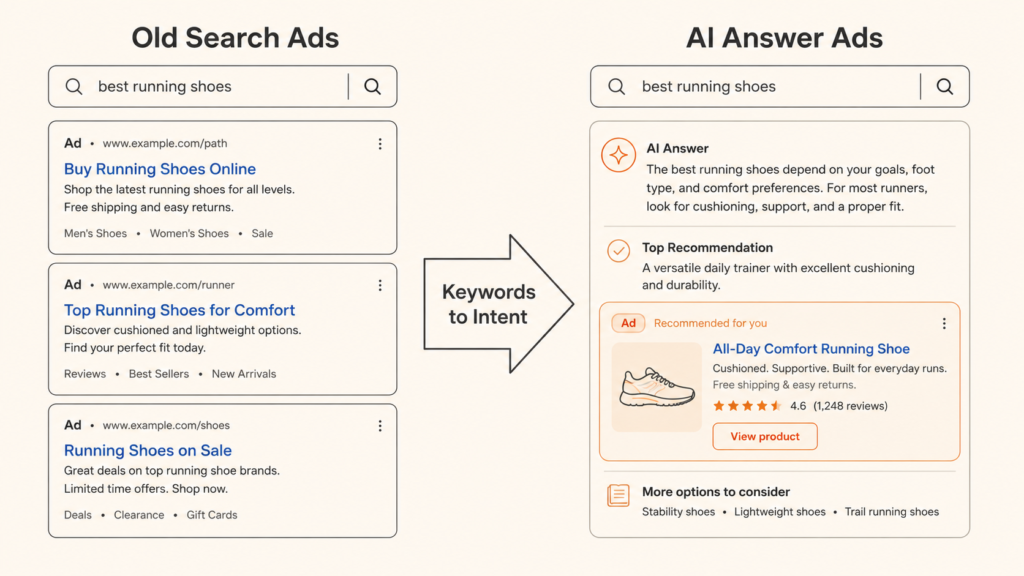
But now Google is changing the place where ads appear and the way those ads are created. With AI becoming part of Search, ads are no longer limited to blue links, headlines, and descriptions. Google is slowly moving ads inside AI-generated answers.
That may sound like a small product update, but for marketers, this is a major shift.
Because if the user’s decision is happening inside the AI answer, then the ad also needs to live inside that answer.
Why Google Is Changing Search Ads?
At Google Marketing Live, Google introduced new AI-powered ad experiences built around Gemini. These updates show how Google wants paid search to work in an AI-first search experience.
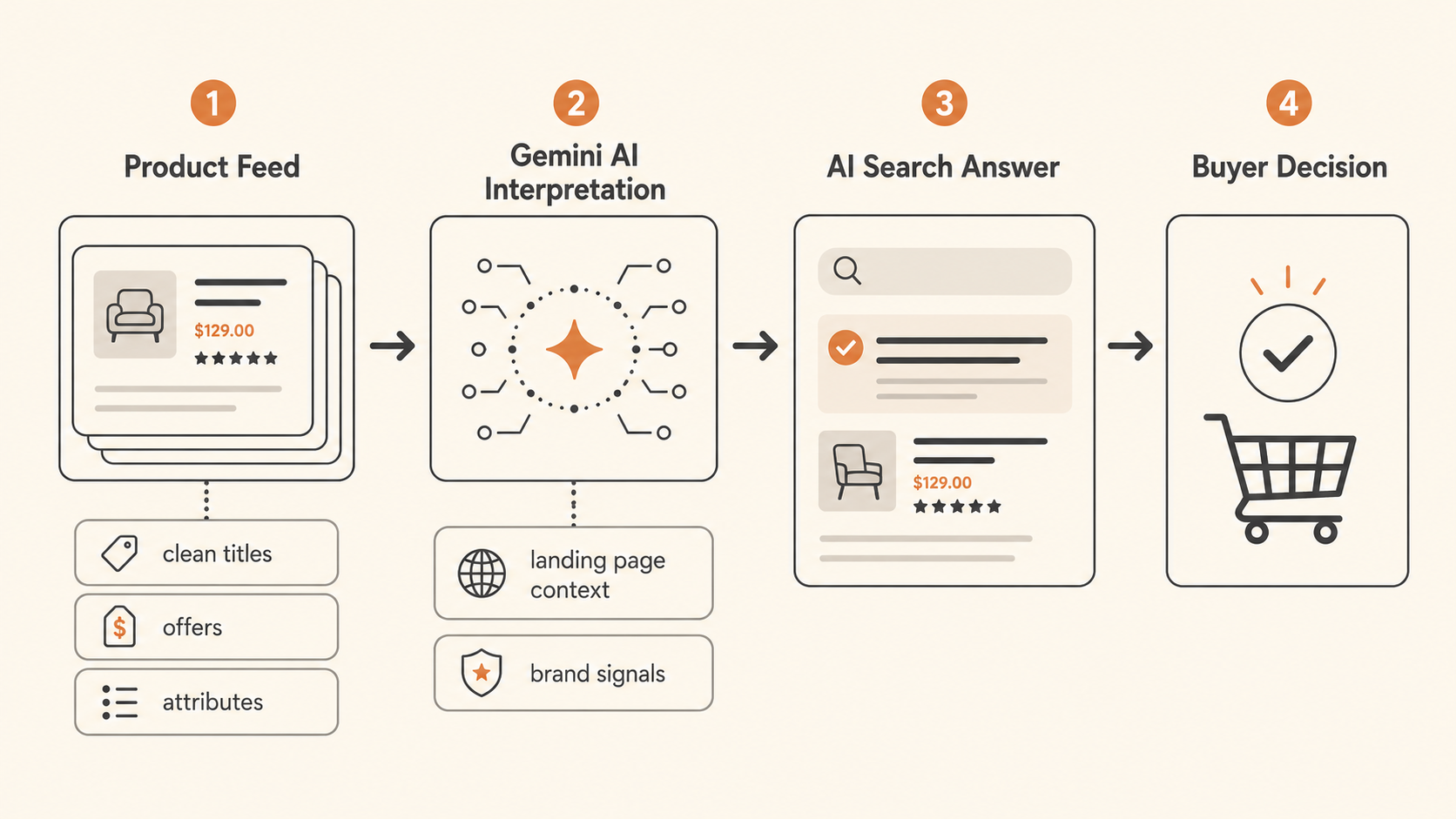
Instead of only showing a traditional search ad with a fixed headline, Gemini can understand the user’s query, interpret the intent, and help generate more relevant ad responses. This means the ad may feel less like a separate ad unit and more like part of the answer experience.
That changes the role of the advertiser.
Earlier, advertisers mainly focused on writing better headlines, stronger descriptions, and cleaner landing pages. Those things still matter, but they may not be enough anymore.
Now, Google’s AI needs the right product data, business information, offers, feed quality, landing page context, and brand signals to create a useful ad response.
In simple words, Google is not just asking advertisers to write better ads.
It is asking them to feed the machine better information.
The Product Feed Is Becoming More Important
This is where many advertisers may struggle.
If AI is going to build or shape ad responses, it needs strong raw material. That raw material comes from product feeds, Merchant Center data, business profiles, website content, campaign assets, and structured information.
A clean product feed can help AI understand what the brand sells, who the product is for, what makes it different, and when it should appear.
A weak product feed does the opposite.
If product titles are messy, attributes are missing, images are poor, pricing is unclear, or offers are not updated, then the AI has less useful information to work with.
That creates a bigger gap between well-managed accounts and neglected accounts.
This is not only a technical issue. It is a marketing strategy issue.
Because in an AI-powered ad system, the brand with better data may get better visibility, better relevance, and better conversion opportunities.
The New Job of the Marketer
This shift changes what performance marketers need to focus on.
Earlier, a lot of search advertising work was about keywords, match types, bids, ad copy, and landing pages. Those are still part of the system, but AI is pushing marketers toward a different type of work.
The new job is to make sure the AI understands the business correctly.
That means marketers need to think about:
What information are we giving Google?
Is our product feed clean?
Are our offers clear?
Is our landing page explaining the product properly?
Are our assets strong enough for AI to use?
Are we giving the system the right guardrails?
This is where marketing analytics and campaign structure become more important. If the data going into the system is weak, the output will also be weak.
AI does not magically fix poor inputs.
It usually exposes them.
Why Advertisers Are Nervous
Advertisers are nervous because this shift gives Google more control over how ads are shown and explained.
In the old model, the advertiser had more direct control over the headline, description, keyword targeting, and landing page message.
In the new AI-driven model, Google may play a larger role in interpreting the query and shaping the ad response.
That creates a trust issue.
Advertisers will want to know:
Is the AI explaining my product correctly?
Is it making claims I did not approve?
Is it showing my offer in the right context?
Is it prioritizing Google’s automation over my brand strategy?
Is performance improving because of better relevance, or because we are giving up more control?
These are not small questions.
When AI becomes part of ad delivery, the advertiser is not only buying media. They are also trusting the platform to represent the brand correctly.
That is why this update matters.
Meta’s Growth Adds More Pressure
The bigger story is not only about Google.
Meta is also growing fast in advertising, and forecasts suggest Meta could overtake Google in digital ad revenue. That shows how much the advertising market is shifting.
For years, Google was the default anchor for many ad budgets because search captured high-intent users. If someone searched for a product or service, they were already close to making a decision.
But Meta has become stronger at using AI to find buyers before they search.
That creates a different type of competition.
Google is trying to protect the decision moment inside Search.
Meta is trying to influence the buyer before that moment happens.
That is why Google moving ads into AI answers makes sense. If the search experience is becoming conversational, Google cannot let ads remain stuck in the old search format.
The ad has to move closer to the answer.
What Brands Should Do Now
Brands should not panic, but they should not ignore this either.
The first step is to audit the quality of their data.
Product feeds, landing pages, creative assets, business descriptions, pricing, inventory, and offers need to be accurate and complete. If Google’s AI is going to use this information to create or support ad experiences, then messy data becomes a direct performance problem.
The second step is to think beyond ad copy.
The future of search ads may not be about who writes the cleverest headline. It may be about who gives the AI the clearest product information, strongest proof points, and most useful business context.
The third step is to monitor how AI-powered ad experiences represent the brand.
If AI is generating explanations, advertisers need to review whether those explanations match the brand’s positioning, offer, and customer promise.
This is where marketers need both creativity and control.
AI can help scale advertising, but brands still need to decide what they want to be known for.
My Perspective
As someone interested in marketing analytics and performance marketing, I think this shift is bigger than a normal Google Ads update.
It shows that paid search is moving from keyword targeting to intent interpretation.
That means marketers cannot only think about campaigns at the ad level. They need to think about the entire information system behind the campaign.
The feed matters.
The landing page matters.
The product data matters.
The brand positioning matters.
The campaign structure matters.
The quality of measurement matters.
AI may create faster ad experiences, but it still depends on the strength of the inputs. If the business gives weak information, the AI will not magically create a strong strategy.
This is also where smaller brands need to be careful. Large brands may have cleaner feeds, better assets, stronger websites, and more historical data. Smaller brands may fall behind if they treat AI ads like a plug-and-play feature.
The marketers who win in this new environment will not be the ones who simply “turn on AI.”
They will be the ones who know how to prepare the data, guide the system, and judge whether the output actually supports the business goal.
Final Takeaway
Google moving search ads into AI answers is not just a format change.
It changes the relationship between search, ads, and decision-making.
The user may no longer move from search query to ad to website in the same old way. The decision may start inside an AI-generated answer, where the platform explains, recommends, compares, and guides the user.
That means advertisers need to rethink what visibility means.
Being present in search may no longer be enough.
Brands need to be understood correctly by the AI layer.
They need clean data, clear offers, strong product information, and better control over how their business is represented.
Search advertising is not disappearing.
But the old version of search ads is being rebuilt.
And for marketers, the next competitive advantage may not be writing the best ad headline.
It may be feeding the AI the best possible version of your business.
Reader Question:
If Google’s AI starts shaping how ads are written, explained, and placed inside search answers, will advertisers gain better performance or lose too much control over their brand message?