When AI Search Gets It Wrong: Why Google’s AI Overview Is Now a Brand-Safety Risk

Court Representation

AI Search Is No Longer Neutral: What Brands Should Learn from Google’s Court Case

AI Search Is Now a Brand-Safety Problem, Not Just an SEO Problem

For years, brands worried about what people said about them on Google.

Bad reviews. Negative articles. Reddit threads. Competitor comparisons. Old complaints that kept ranking.

But now the problem is changing.

It is no longer only about what websites say about your brand. It is also about what Google’s AI says after reading those websites, summarizing them, and presenting the answer directly to users.

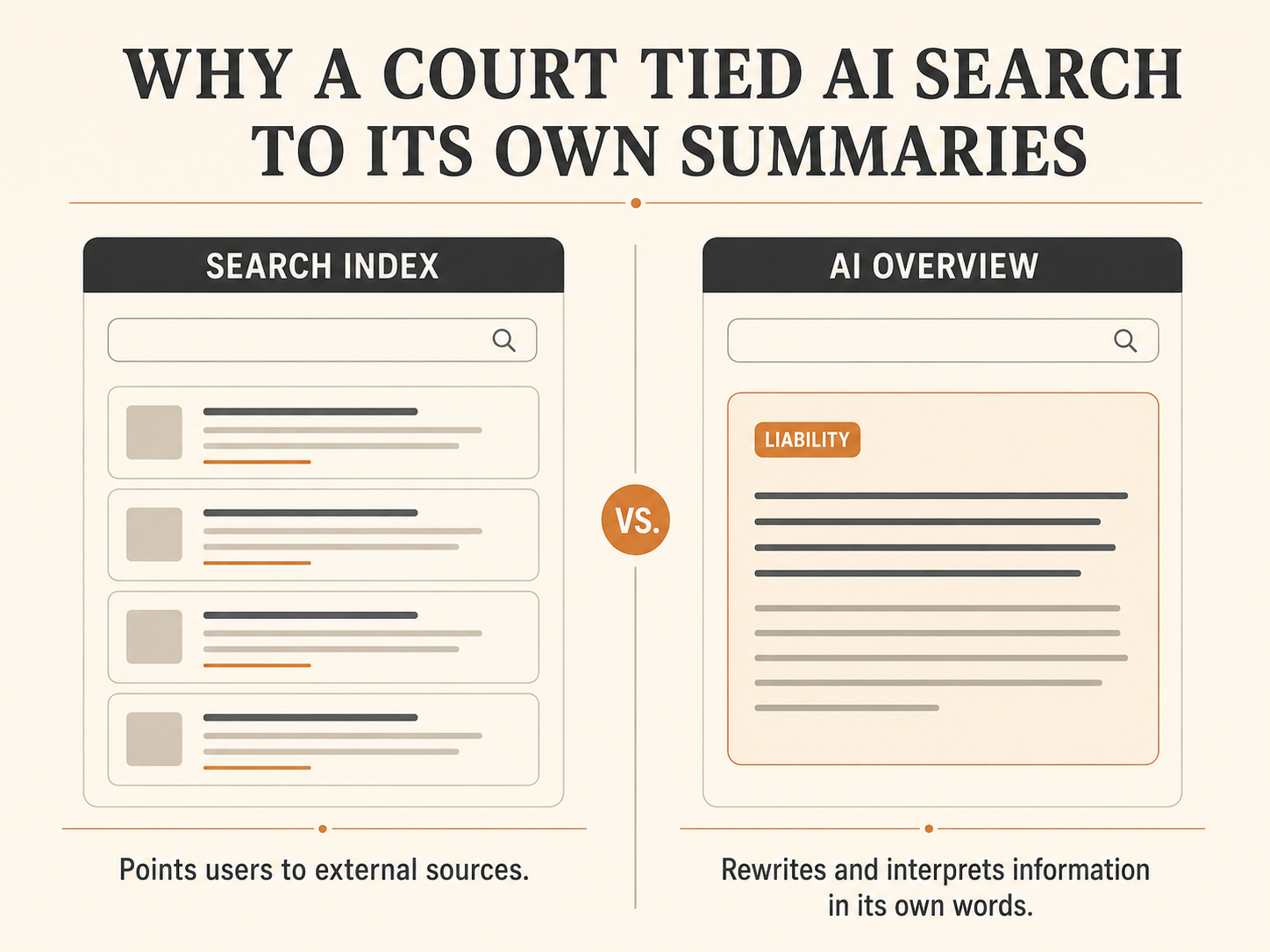
That shift matters because AI search does not behave like traditional search. A normal Google result points users toward a list of sources. An AI Overview does something more powerful. It reads, rewrites, summarizes, and gives users a direct answer in Google’s own interface.

That sounds useful when the answer is accurate.

But when the answer is wrong, it becomes a brand reputation problem.
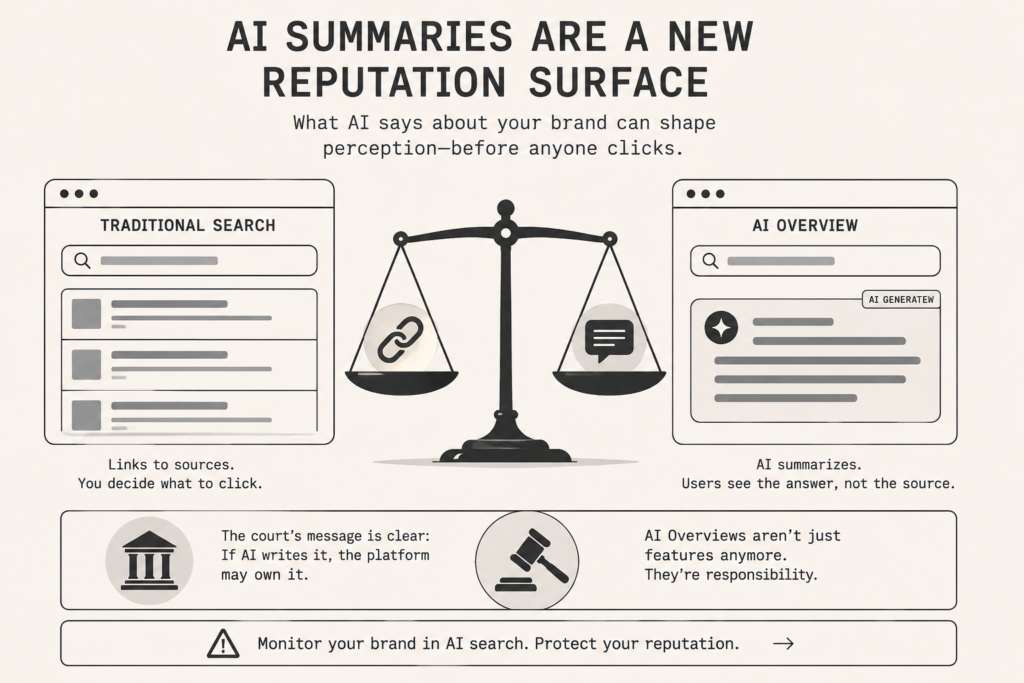
 

Graphical representation

A recent court decision in Germany shows why this matters.

A German Court Just Sent a Warning to AI Search Platforms

A regional court in Munich reportedly ruled that Google can be held responsible when its AI Overview makes false claims about a brand.

The issue involved two Munich publishing companies. Google’s AI Overview had connected them to scams and “subscription traps,” even though the cited sources did not support those claims.

That detail is important.

The problem was not simply that Google showed a bad search result. The problem was that Google’s AI layer created a summary that appeared to make its own judgment. It did not just send users to another website. It interpreted the information and presented the result as an answer.

That is where the legal and marketing issue begins.

Traditional search has always been built around links. Google could say it was indexing the web and helping users find information. But AI Overviews work differently. They do not only index information. They convert information into a finished response.

For brands, that changes the risk.

If an AI summary says something false about your business, many users may never click through to check the original sources. They may simply trust the answer because it appears directly inside Google.

That makes the AI summary itself a new reputation surface.

Why This Is Bigger Than a Legal Story

At first, this might look like a legal case about one court, one country, and one AI Overview.

But the bigger lesson is about how brand visibility is changing.

In the old search world, brands mainly cared about rankings. If your website ranked well, you had visibility. If negative content ranked above you, you had a reputation problem. If your competitors outranked you, you had an SEO problem.

Now, ranking is only part of the story.

AI search creates another layer between the user and the web. That layer decides what to summarize, what to ignore, what to connect, and what to present as the final answer.

That means brands are no longer competing only for search rankings. They are competing for how AI systems understand them.

This is a major shift for marketers.

A brand could have strong SEO, good website content, and positive press coverage, but still be misrepresented by an AI-generated summary. The user may never see the full source. They may only see the AI answer.

That creates a new question for every business:

What does AI believe about your brand?

AI Overviews Are Becoming a Reputation Surface

Every brand already has reputation surfaces.

Your website is one.

Your Google Business Profile is one.

Your reviews are one.

Your social media presence is one.

Your Reddit mentions, press articles, YouTube videos, and third-party listings are all part of the public picture.

Now AI Overviews need to be added to that list.

The difference is that brands cannot directly edit AI Overviews the way they can edit their website or Google Business Profile. The AI summary is generated from a mix of sources, signals, and context that the brand does not fully control.

That makes it harder to manage.

If your website has outdated information, you can update it.

If your landing page has weak copy, you can rewrite it.

If your ad campaign has poor messaging, you can pause it.

But if an AI Overview creates a false or misleading summary, the path to fixing it is less clear.

That is why this court decision matters. It suggests that when AI search platforms generate their own summaries, they may also carry responsibility for what those summaries say.

For brands, that creates both a risk and a possible protection.

Why Marketers Should Care

This is not only a legal issue. It is a marketing operations issue.

Marketers already monitor rankings, traffic, conversions, reviews, social mentions, and campaign performance. AI search monitoring may now need to become part of that same system.

If your brand appears in AI Overviews, you need to know what is being said.

Search your brand name.

Search your brand name with words like scam, lawsuit, complaints, pricing, refund, reviews, problems, and alternatives.

Do the same for your top products, services, executives, and competitors.

This is not paranoia. It is reputation hygiene.

The danger is not only that AI gets something wrong. The danger is that the wrong answer appears confident, polished, and official enough for users to believe it.

That is what makes AI-generated misinformation more serious than a random bad comment online.

A bad comment looks like a comment.

A bad AI summary can look like an answer.

The New Brand-Safety Checklist

Brands should start treating AI search as part of brand safety.

That means creating a simple monitoring process.

First, check how your brand appears in AI Overviews.

Second, document anything false, misleading, or unsupported.

Third, take screenshots with dates.

Fourth, compare the AI answer with the sources it claims to use.

Fifth, update your own website content if your public information is unclear, incomplete, or outdated.

Sixth, build stronger third-party signals through credible articles, profiles, case studies, and structured content.

This does not mean every company needs a massive AI search team. But it does mean companies need a habit.

The brands that ignore this will find out late.

The brands that monitor early will understand how AI systems are interpreting them before it becomes a larger reputation issue.


My Perspective:

From a marketing analytics and performance marketing perspective, this case shows that visibility is no longer just about clicks.

For a long time, marketers measured search mainly through rankings, impressions, CTR, and organic traffic. Those metrics still matter, but they do not fully explain what is happening in AI search.

If a user reads an AI Overview and never clicks, the brand may still be influenced positively or negatively.

That means the impact happens before the website visit.

This is where traditional analytics becomes weaker. GA4 may show fewer visits. Search Console may show impressions and clicks. But neither tool fully explains how AI summaries are shaping perception before the click.

That is why marketers need to think beyond traffic.

The question is not only, “Did the user visit our site?”

The better question is, “What did the user learn about us before deciding whether to click?”

That is the new search reality.

Final Takeaway:

The German court case is a signal of where AI search is heading.

AI Overviews are not just search features. They are becoming public-facing brand narratives. They summarize companies, judge context, and influence what users believe.

For brands, this creates a new responsibility: monitor how AI describes you.

For platforms, it creates a new pressure: if the AI writes the answer, the platform may not be able to hide behind the idea that it only showed users a link.

Search is no longer just about being found.

It is about being understood correctly.

And in an AI-driven search world, that may become one of the biggest brand-safety challenges marketers have to manage.

Reader Question:

If Google’s AI gives a false summary about a brand, who should be responsible  the platform, the original sources, or the brand for not monitoring it early enough?

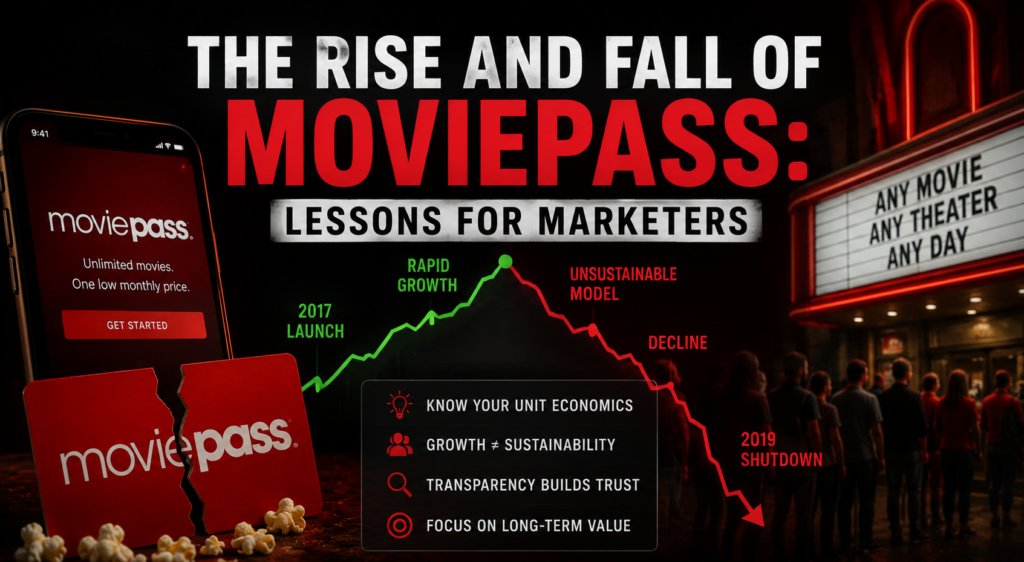
The Rise and Fall of MoviePass: Lessons for Marketers

Movie pass

The Rise and Fall of MoviePass: Lessons for Marketers

In the ever-evolving landscape of marketing, the story of MoviePass stands as a cautionary tale. Launched in 2017, MoviePass offered an irresistible deal: one movie ticket per day for just $9.95 a month. This groundbreaking offer created a massive wave of subscriptions, attracting over two million users within six months. However, this meteoric rise was followed by an equally dramatic fall, leading to the company’s collapse in 2019. Understanding the missteps of MoviePass is crucial for marketers today, especially as businesses navigate the challenges posed by disruptive pricing strategies and customer expectations.

 The MoviePass saga is not merely about a failed business; it encapsulates vital lessons about aligning marketing promises with business realities. As we delve deeper into this case, we will uncover the key marketing mistakes made by MoviePass and how modern marketers can avoid similar pitfalls.

Rise and fall of movie pass

The Allure of an Irresistible Offer

The first major takeaway from the MoviePass experience is the power of an irresistible offer. The company’s $9.95 subscription was not just a price point; it was a marketing phenomenon that generated buzz and viral word-of-mouth. It was so compelling that it required little traditional advertising subscribers did the marketing for MoviePass by sharing their excitement on social media and news outlets.

 However, this success also highlighted a significant flaw: the offer was unsustainable. MoviePass paid theaters the full ticket price, leading to massive losses with every transaction. Marketers must recognize that while attractive offers can drive customer acquisition, they must be backed by a feasible business model. A marketing strategy must consider not only how to attract customers but also how to retain profitability.

The Dangers of Adverse Selection

One of the critical miscalculations by MoviePass was its assumption about customer behavior. The company believed that most subscribers would be light users, taking advantage of the subscription only a few times a year. In reality, the offer attracted avid moviegoers who utilized the service frequently, leading to higher operational costs than anticipated. This phenomenon, known as adverse selection, occurs when an offer disproportionately attracts customers who are more costly to serve.

For contemporary marketers, this illustrates the importance of understanding customer segments and their behaviors. When designing offers, it’s essential to conduct thorough market research to anticipate how different customer groups will respond. Building customer personas can help businesses tailor their marketing strategies to attract the right customers, thereby avoiding adverse selection pitfalls.

The Consequences of Broken Promises

As financial pressures mounted, MoviePass began altering its service terms, imposing blackout dates and removing popular movies from its platform. These changes eroded consumer trust and loyalty, and the company’s once-strong brand image suffered immensely. When customers feel misled, the damage to brand reputation can be irreparable.

This scenario serves as a stark reminder for marketers: trust is an invaluable asset. Maintaining transparency with customers and delivering on promises is crucial. If companies must pivot or adjust their offerings due to unforeseen circumstances, clear communication is essential to preserve customer relationships. Brands that prioritize honesty and transparency are more likely to build lasting loyalty and mitigate the risk of backlash.

shake hands

Scaling Without a Sustainable Model

MoviePass’s ambition to scale rapidly ultimately contributed to its downfall. The company believed that by amassing a large user base, it could leverage data and negotiate better terms with theaters. However, it failed to establish a sustainable revenue model, which only multiplied its financial losses.


For marketers, this highlights the importance of aligning growth strategies with sustainable practices. When planning for scale, businesses should develop robust financial models that account for potential customer usage patterns and the costs associated with fulfilling customer demand. A well-thought-out growth strategy should focus not only on acquiring customers but also on ensuring that the business can effectively meet their needs without jeopardizing profitability.

Key Takeaways for Today's Marketers

The story of MoviePass is a rich source of lessons for modern marketers. First, while attractive offers can drive initial success, they must be sustainable. Second, understanding customer behavior is crucial to avoid adverse selection. Third, maintaining transparency is essential for building trust, especially when changes to service occur. Finally, scaling a business requires a sustainable model that aligns customer demand with operational capabilities.

raising

MY PERSPECTIVE:

As a professional focused on marketing analytics and brand strategy, the MoviePass case underscores the necessity of integrating marketing efforts with business realities. Marketers need to leverage data to understand their customer base deeply, ensuring that their strategies align with not only customer desires but also the financial health of the business. Implementing rigorous analytics will help in modeling scenarios that predict customer behavior and the impact of offers on profitability.

What lessons have you learned from marketing campaigns that didn’t go as planned?

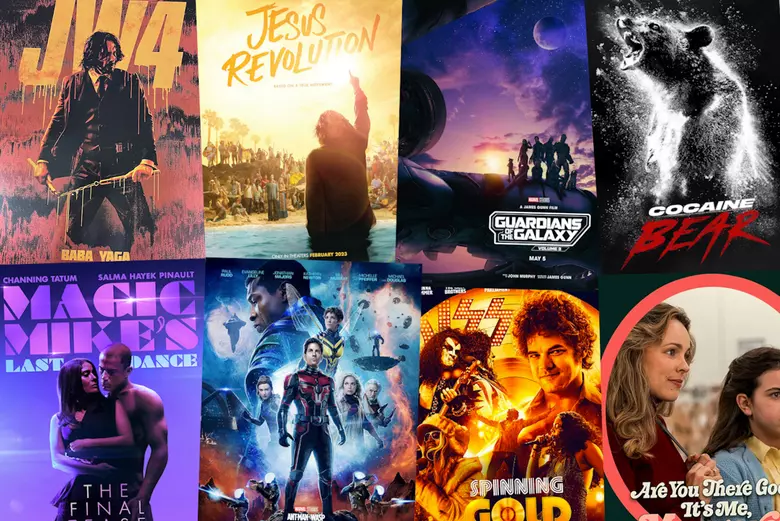
The Art of the Tease: What Makes a Movie Trailer Truly Unforgettable?

movie posters


Have you ever walked out of the theater humming a tune from a trailer or found yourself replaying a teaser on YouTube long after the credits rolled? You’re not alone. Even in the age of endless streaming and social-media scrolls, a great trailer still wields serious marketing magic. In fact, sisters Monica and Evelyn Brady co-founders of the Golden Trailer Awards have spent the last 25 years celebrating the craft behind those two-minute mini-movies that convince us to open our wallets (or at least hit “Add to Watchlist”).

After interviewing the Bradys, veteran trailer editor Benedict Coulter, and digging into industry trends, I’ve distilled the key ingredients that turn a simple preview into an unskippable cinematic appetizer. Whether you’re a filmmaker, marketer, or just a die-hard movie buff, here’s what you need to know.


1. Keep It Tight, But Make It Count

Sweet spot: roughly 90 seconds to 2 minutes.
Today’s audiences have razor-short attention spans, so any teaser that creeps past the two-minute mark risks feeling long in the tooth. Compare that with the sprawling, voice-of-God promos of the 1970s (some ran six or seven minutes!), and it’s clear the pacing game has changed.

“If you go back and watch those ’70s trailers, you’re crawling out of your skin,” Monica Brady jokes.

Digital platforms do allow for extended cuts or “special looks,” but the first bite has to be snack-sized just enough to spark curiosity without giving the plot away.


2. Hook the Heart Before the Head

Think of a trailer as a first date: you’re not rattling off your life story, you’re creating intrigue. The Bradys swear by an emotional anchor one unforgettable image, line of dialogue, or needle-drop that makes viewers feel something immediately. That feeling sticks far longer than a bullet-point list of plot exposition.

  • For action flicks: A pulse-pounding stunt or perfectly timed beat drop.

  • For intimate indies: A lingering close-up, a whispered confession, a single relatable moment.

  • For horror: A slow visual reveal that leaves the real scare off-screen (our imaginations fill in the blanks).


3. Let the Music Do the Heavy Lifting

If trailers were cocktails, music would be the secret bitters that tie the whole flavor profile together. Evelyn Brady calls the auditory recall of a great track “marketing gold.” The first three notes of the right song can raise goosebumps faster than any explosion. Veteran producer Jerry Bruckheimer built entire campaigns around that principle just think of the Top Gun anthem and how it primes you for speed and sky-high adrenaline before Tom Cruise even removes his helmet.

Insider tip: Modern editors often experiment with slowed-down pop hits or moody orchestral covers. Familiar songs in unfamiliar arrangements create instant recognition plus fresh intrigue.


4. Upend Expectations (Just Enough)

Studios still rely on tried-and-true trailer “formulas” because news flash they work. But the trailers people gush about? Those often zig when everyone else zags.

“If seven trailers follow the same blueprint and one breaks the rules, guess which one you’ll remember?” Coulter says.

Maybe it’s a fake-out jump scare, an unexpected tonal shift, or a mid-teaser mic drop that reveals the real genre twist. The key is balancing risk with clarity; surprise us, but don’t confuse us.


5. Respect the Audience, Don’t Spoil the Payoff

Nothing torpedoes excitement faster than a preview that spills the movie’s third-act twist. While marketing departments sometimes demand “more plot, more plot,” top editors push back, arguing the movie’s best moments belong on the big screen, not in your feed.

Evelyn’s rule of thumb: If the entire story fits in two and a half minutes, maybe the feature itself needs another revision pass.


Why It Matters (Far Beyond the Box Office)

Trailers aren’t just ads they’re cultural touchpoints. An unforgettable teaser can:

  • Catapult a micro-budget indie into mainstream conversation (think Whiplash or Everything Everywhere All at Once).

  • Define a franchise’s identity before the opening weekend (Deadpool’s sardonic red-band trailers basically wrote the character’s cinematic rulebook).

  • Spark viral fandomb: hello, social-media reaction videos, mash-ups, and Easter-egg breakdowns.

And on a human level? A great trailer gives us something intangible: anticipation. That giddy, seat-shuffling feeling that reminds us why we fell in love with movies in the first place.


Takeaways for Creators and Marketers

  1. Lead with emotion. Hook the viewer’s gut before their brain.

  2. Trim the fat. Respect modern attention spans (aim for two minutes or less).

  3. Choose music with purpose. The first few notes should set an unmistakable mood.

  4. Dare to deviate. A dash of novelty makes your teaser pop in a sea of sameness.

  5. Leave them wanting more. If you spoil the finale, you squander the ticket sale.

Whether you’re cutting your first indie trailer in a cramped editing suite or green-lighting a mega-budget marketing push, remember: trailers are tiny works of art. When designed with care, they don’t just preview a story they become part of the story we tell about going to the movies.

So next time you catch yourself humming that catchy trailer track on the drive home, thank the editors, musicians, and marketing mavericks who turned two short minutes into a lasting memory and maybe, just maybe, sold you your next favorite film.

Unlocking the Power of Empathy, Story and Connection: Lessons from Seth Godin’s This Is Marketing

person reading a book

Marketing isn’t about shouting the loudest; it’s about whispering the right story to the right person. In This Is Marketing, Seth Godin reframes marketing as an act of generosity and service. Here are some of the most compelling ideas he shares and what you can take away for your own work.


1. Find Your “Smallest Viable Audience”

What Godin Says:

“You can’t be everything to everybody. Instead, decide whom you’re for and build a product and story that resonates deeply with that group.”

Why It’s Powerful:

  • Shifts focus from mass appeal to meaningful connection

  • Encourages authenticity: you serve fewer people better

  • Builds word-of-mouth momentum as delighted customers become evangelists

Your Takeaway:

  • Define your niche in human terms interests, values, identity

  • Craft messaging that speaks directly to their needs and aspirations

  • Resist the temptation to water down your offer for the sake of “broader” appeal


2. Lead with Empathy and Story

What Godin Says:

“People like us do things like this.”

Why It’s Powerful:

  • Stories bind us together; they help customers see themselves in your narrative

  • Empathy lets you anticipate objections and speak to real fears or desires

  • Shared identity (“people like us”) creates a sense of belonging

Your Takeaway:

  • Use customer interviews to uncover the stories they tell themselves

  • Position your product or service as the missing chapter in their narrative

  • Maintain consistency across every customer touchpoint (website, email, social media)


3. Embrace “Permission Marketing”

What Godin Says:

“The best marketing doesn’t feel like marketing.”

Why It’s Powerful:

  • Breaks with interruptive tactics (pop-ups, cold calls) that annoy today’s savvy consumer

  • Builds trust over time by delivering valuable content before pitching an offer

  • Turns subscribers into loyal fans who eagerly await your next message

Your Takeaway:

  • Offer genuine value (tips, insights, stories) in exchange for attention or contact details

  • Respect customers’ inboxes: send only what you’d be excited to receive

  • Nurture relationships with a predictable cadence email, social media, events


4. Create and Amplify Tension

What Godin Says:

“Marketing is the generous act of helping someone solve a problem they’ve come to you to solve.”

Why It’s Powerful:

  • Tension (the gap between where people are and where they want to be) is the engine of all change

  • A well-defined tension makes your solution feel urgent and essential

  • Without tension, even the best products can languish unnoticed

Your Takeaway:

  • Identify the emotional or practical pain point your audience experiences daily

  • Frame that pain point vividly in your messaging don’t shy away from discomfort

  • Position your product as the bridge from “now” to “next”


5. Focus on Status Change

What Godin Says:

“People buy status they want to be seen differently by themselves and by others.”

Why It’s Powerful:

  • Status signals (“I’m a serious baker,” “I’m an eco-warrior”) drive purchasing decisions

  • Marketing that elevates customers’ status resonates at a deeper emotional level

  • Products with clear status benefits create enthusiastic brand advocates

Your Takeaway:

  • Ask: “What new badge of honor does my product confer?”

  • Reflect that status in your branding, packaging, and community language

  • Celebrate customers publicly to reinforce the perception of prestige


6. Marketing Is Service, Not a Zero-Sum Game

What Godin Says:

“Marketing done right is making change happen for the better.”

Why It’s Powerful:

  • Reframes marketing from manipulation to mutual benefit

  • Positions you as a trusted guide rather than a faceless seller

  • Encourages ethical choices and long-term thinking

Your Takeaway:

  • Always ask: “How does this help my customer?”

  • Align your marketing actions with your core values transparency, integrity, generosity

  • Measure success not just in sales, but in customer outcomes and community impact


Bringing It Home: What You Can Learn

  1. Narrow Your Focus
    You’ll achieve more by serving fewer people better.

  2. Speak Their Language
    Empathy and story transform prospects into passionate raving fans.

  3. Build Trust First
    Invest in permission marketing give before you ask.

  4. Sell Transformation
    Highlight the tension your product resolves and the status it confers.

  5. Serve, Don’t Trick
    When marketing is an act of service, you cultivate loyalty and make a lasting difference.


Whether you’re launching a side hustle, growing a nonprofit, or leading a global brand, This Is Marketing offers a blueprint for change-centric, humane marketing. Its lessons remind us that at its heart, marketing is an invitation: to join a community, solve shared problems, and elevate each other’s stories.

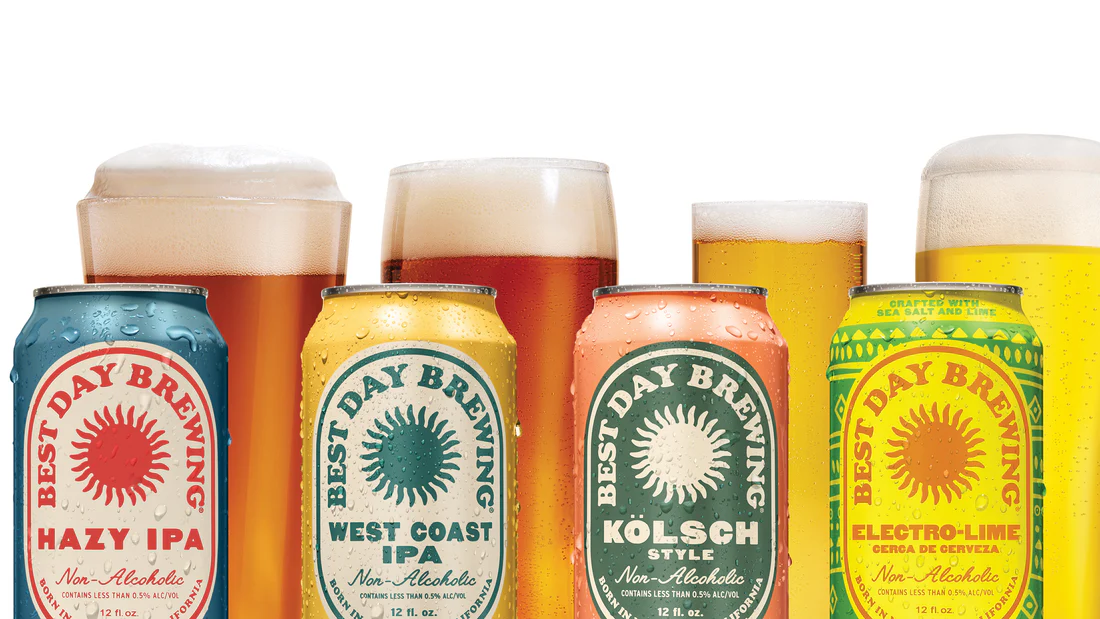
How Days Beer Tapped Into the Mindful Drinking Movement and Built a Bold, Authentic Brand.

cans line up

🍺 The Rise of Days Beer: A Mindful Twist on a Classic Ritual For many, beer marks their first sip into the world of alcohol.

Recently though, the market has been bubbling with fruit beer alternatives beverages that resemble beer in look and feel but come with zero alcohol.

This shift has been largely fueled by younger consumers rethinking their relationship with alcohol, even as they continue reaching for a beer during social moments.

Enter Days Beer a UK-based alcohol-free beer company founded in 2020 by Mike Gammell and Duncan Keith.

Riding the Mindful Drinking Wave
At the heart of Days Beer lies a powerful cultural undercurrent: the mindful drinking movement.

Brewed in Scotland with locally sourced ingredients, Days doesn’t try to mimic beer by being watered-down it is beer, just without the alcohol or hangover.

The brand is built around guilt-free indulgence, offering the full experience taste, ritual, and vibe without any negative aftereffects.

So how did Days carve out a strong presence in a market dominated by old-school giants and skeptical consumers?

Let’s dive in.

Branding That Sticks The core insight behind Days:  you shouldn’t have to choose between your health and having a beer.

Mike and Duncan set out to create a brand that delivers the full beer experience from the taste and ritual to the satisfaction without alcohol.

What makes them stand out is their authenticity. The founders made their own personalities a part of the brand from day one, giving it a human, relatable feel.

And there’s zero pretension here. Days isn’t trying to be a fancy craft beer, it’s just a smart, clean alternative that fits seamlessly into real lives.

Importantly, the brand isn’t just for sober folks or for “Dry January.” It’s designed to blend into everyday routines without disrupting them.

Psychology-Driven Positioning Where traditional alcohol brands promote escapism, Days flips the narrative it’s about enhancing your life.

They also walk the talk B-Corp certified, with 2% of profits donated to mental health initiatives through their “Days Duty” program.

Who’s Drinking Days?
Their main consumer base? Health-conscious Millennials and Gen Z.

These are people who read nutrition labels, track their steps, and are tuned into their mental well-being.

Many fall into the “sober curious” camp experimenting with reducing alcohol intake without giving it up completely.

You’ll also find athletes, creatives, wellness enthusiasts, and productivity-focused professionals in their tribe.

For some, it’s about improving sleep or avoiding the post-drink blues. For others, it’s about clarity and hitting personal milestones.

Days doesn’t preach sobriety it offers a smarter alternative, giving people room to explore their own reasons for cutting back, including that all-too-familiar “hangxiety.”

Facing the Competition
Days is up against names like Beneficial Beer, Nirvana Brewery, and Beavertown Brewery, along with industry giants like Northern Monk, and Heineken’s alcohol-free line.


Here’s how they stack up:

Aspect

Days Brewing

Competitors (e.g. Northern Monk)

Leaders (Heineken, AB InBev)

Market Position

Fastest growing low/no-alcohol brand in the UK

Established low-alcohol products

Broad portfolio, global presence

Growth Rate

160% retail sales growth in 2024

Lower growth rates

Stable growth, focused on volume

Distribution

Major UK supermarkets + Majestic

Supermarkets & pubs

Extensive international distribution

Marketing

Viral TikTok, witty OOH campaigns

Traditional & digital marketing

Massive budgets, broad reach

Products

0.0% Pale Ale & Lager with premium ingredients

Varied alcohol-free beers

Wide range with alcohol-free options

Brand Values

B-Corp certified, mental health focus

Varies

CSR programs

The Marketing Mix

Product:

Days founders spent a year refining a 0.0% alcohol beer using traditional methods. The final product uses premium barley and fresh water from the Lammermuir Hills. The flavor profiles include Pale Ale and Lager, both available in cans and bottles and yes, they fit into a pint glass, preserving the familiar ritual.

Price:

Days leans premium, focusing on value through quality and connection rather than undercutting competition. Pricing adjusts slightly by setting sharp but premium prices in supermarkets and online, a bit higher in pubs and bars.

Place:

Their omnichannel distribution includes their website, Amazon, and a subscription model with a 20% lifetime discount. They partner with Huboo for fulfillment and have strong retail visibility with Tesco, Ocado, and even Wagamama. Their Majestic Wine partnership (200+ stores) especially pushes their Pale Ale.

This smart retail network helped Days drive a 160% YoY sales increase in 2024.

Viral Content = Real Sales

Social Media

Days nailed TikTok.

Rather than just being there, they blended in while standing out with relatable content, authentic storytelling, and no salesy fluff.

They brought founders and employees into the spotlight, creating a human connection.

When the #TubeGirl trend exploded, Days asked followers if they wanted to see the founders do it. When they did, it blew up:

20M+ views


53K+ new followers


432% spike in website traffic


Best-ever sales week at Tesco


All from a single viral video.


OOH (Out-of-Home)

Dry January is prime time but highly competitive.

Days went all-in with 31 unique messages one for each day across taxis, buses, tube stops, and digital screens throughout the UK.

Their central message?

“There are loads of reasons not to drink alcohol, but no reason not to drink beer.”

Emily Jeffery-Barret, Co-Founder, Among Equals

Final Thoughts: Why Days Wins

Days isn’t just selling a product, it’s selling a mindset.

In a category long ruled by legacy names and booze-fueled rituals, they’ve carved out a new path one powered by empathy, cultural awareness, and some seriously clever marketing.

 Key Takeaways (Screenshot This!)

  •  Lean into cultural shifts, not just demographics

  •  Build authenticity by spotlighting your team

  • Jump on viral trends fast (hello, TikTok!)

  •  Position the product around life moments, not just parties

  •  Sell satisfaction, not sobriety

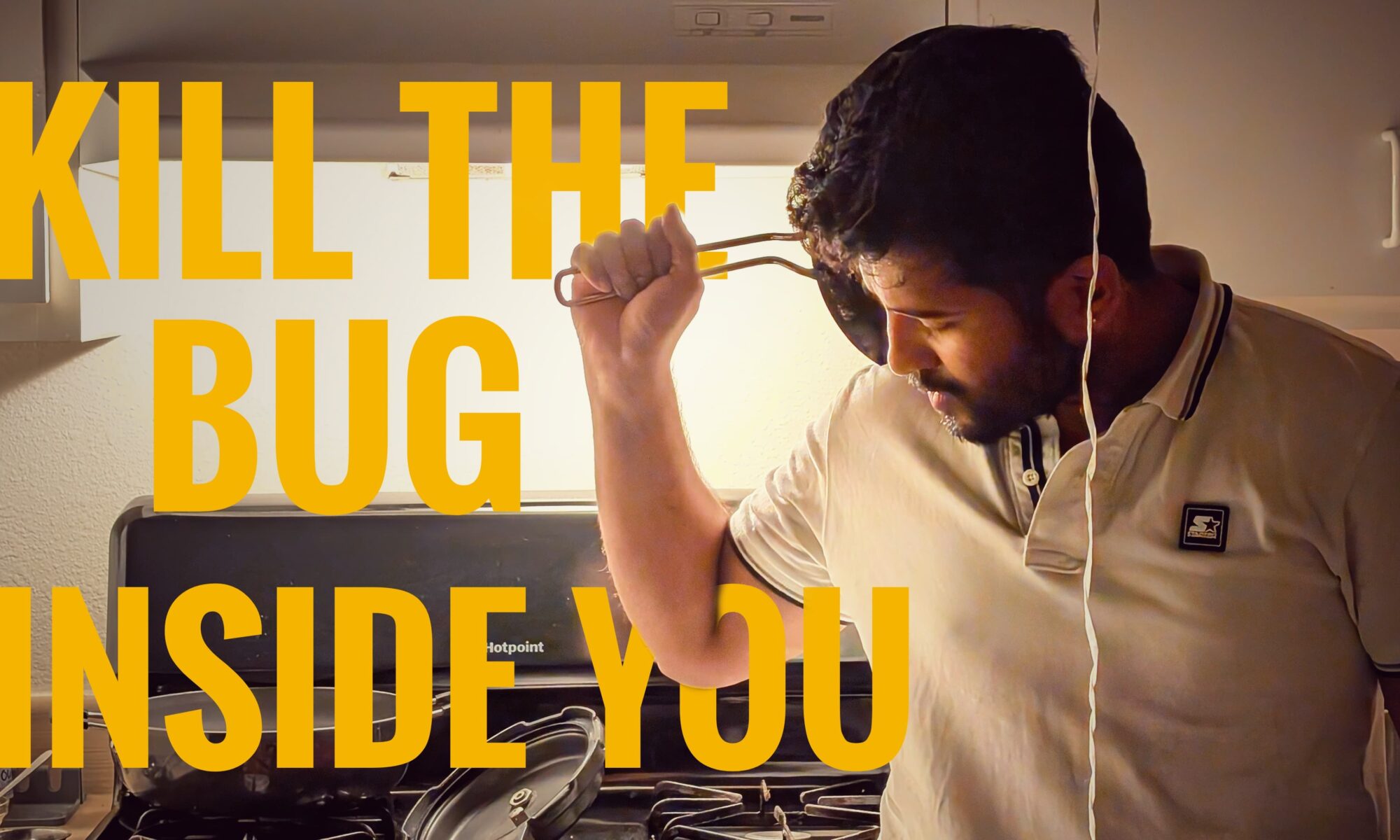
Kill The Bug Inside You!!

Man with a Pan

Kill the Bug Inside You - "A Marketing Nightmare Turned Success"

The Incident: A Campaign Gone Wrong
In 2018, a well-known health supplement brand launched a digital campaign promoting its new probiotic product. The campaign targeted young professionals struggling with digestive issues, using the tagline “Kill the Bug Inside You.”

However, within hours of going live, the campaign faced unexpected backlash. Social media users misinterpreted the tagline, associating it with mental health struggles rather than gut health. Some accused the brand of being insensitive, while others found the message confusing. Hashtags like #MarketingFail and #InsensitiveBranding began trending.

The Redemption: Smart Crisis Management
The marketing team, realizing the mistake, took immediate action. They:

Acknowledged the confusion – The brand issued a public statement apologizing for the unintended interpretation.

Engaged the audience – Instead of deleting the campaign, they launched a follow-up with influencers explaining the real meaning behind the tagline.

Rebranded the message – A revised campaign shifted focus to “Kill the Bad Gut Bacteria, Feel Better Inside.”

Leveraged controversy – The buzz helped drive conversations about gut health, increasing website visits by 300% in a week.

The Outcome: A Viral Success
What started as a marketing disaster turned into a huge success. The revised campaign led to a 25% increase in sales, and the brand was praised for its quick response.

Lesson for Marketers:
Test taglines across different demographics before launch.

Monitor public sentiment and react quickly.

Turn negativity into an opportunity by engaging in honest communication.

Even the best marketers face “bugs” in their strategies. The key is to kill the bug inside before it ruins the campaign!

Burger King’s Marketing Strategy: The Art of Playful Rivalry

Burger king foundation

Founded in 1954 in Jacksonville, Florida, by James McLamore and David Edgerton, Burger King set out to popularize flame-grilled burgers. Originally named “Insta-Burger King,” the brand underwent early rebranding, dropping “Insta” to become the well-known Burger King. A major milestone was the introduction of the Whopper in 1957, priced at just 37 cents. This signature burger helped the brand stand out in an increasingly competitive fast-food industry.

Industry Overview and Marketing Tactics

The global fast-food industry is projected to hit $1,186.44 billion by 2032, with key players like McDonald’s, Wendy’s, Subway, and KFC. The franchise model has been a significant driver of success, allowing rapid expansion with minimal capital investment from parent companies. Burger King effectively leveraged this strategy, with only 50 of its 19,789 outlets company-owned, while the rest operate as franchises.

Burger King follows industry best practices, such as:

  • Family-Friendly Advertising: Targeting families to build trust.
  • Discounts & Loyalty Programs: Incentives like Buy 1 Get 1 Free drive repeat business.
  • Delivery Partnerships: collaborating with Uber Eats, Zomato, and Swiggy for accessibility.
  • Strategic Locations: Positioning in malls, multiplexes, and high-footfall areas.
  • App-Based Ordering: Encouraging digital engagement and repeat purchases.

Burger King’s Entry into India

Burger King entered India in 2014, partnering with Everstone Capital for its franchise operations, while McDonald’s had already been in the market for 18 years. Understanding the importance of adaptation, Burger King localized its strategy by:

  • Introducing a Vegetarian Menu: Items like Paneer King and Tikki Twist cater to India’s large vegetarian demographic.
  • Focusing on Price Sensitivity: Budget-friendly meal combos made the brand accessible to cost-conscious consumers.
  • Adding Localized Flavors: Burgers like the Masala Whopper balanced global identity with Indian taste preferences.

This strategic approach helped Burger King become one of the fastest-growing fast-food brands in India.

Bold Marketing Campaigns

1. Whopper Detour

In 2018, Burger King used geofencing to offer a $0.01 Whopper to customers placing orders near a McDonald’s outlet. 

  • Impact:
    • 1.5 million+ app downloads
    • 3.3 billion impressions
    • 3x increase in mobile sales

2. Burn That Ad

A creative Augmented Reality (AR) campaign allowed customers to virtually “burn” McDonald’s ads via the Burger King app, earning a free Whopper in return. This gamified experience boosted engagement and brand recall.  

3. Moldy Whopper

To highlight its no artificial preservatives policy, Burger King launched a campaign featuring a Whopper rotting over 34 days. While controversial, it reinforced the brand’s commitment to natural ingredients, in contrast to McDonald’s famously non-decomposing burgers. 

4. Google Home of the Whopper

In 2017, a Burger King commercial triggered Google Home devices to read out Whopper descriptions from Wikipedia. Although Google quickly disabled the feature, the stunt went viral, showcasing Burger King’s innovative thinking. 

5. Stevenage Challenge

By sponsoring Stevenage FC, a lesser-known English football club, Burger King encouraged FIFA gamers to play with the team and earn branded rewards.

  • Club’s home jerseys sold out
  • Millions of eyes on Burger King’s branding in FIFA 20
  • User-generated content featuring top football stars

6. Net Neutrality Whopper

Burger King tackled the net neutrality debate by simulating tier-based pricing for Whoppers, mirroring the impact of unequal internet access. The campaign effectively simplified a complex issue for mass audiences.

Key Takeaways

Burger King’s bold, risk-taking marketing has cemented its position as a memorable brand. From leveraging local market insights to engaging audiences with unconventional ad campaigns, the company continues to push the boundaries of traditional advertising.


“Great marketing isn’t just about selling a product it’s about creating conversations, challenging norms, and leaving a lasting impression. Burger King proves that boldness, creativity, and a little playful rivalry can turn a brand into a cultural icon.”

Most of us associate Santoor with the ‘Santoor Mom’ ads:

Mom holding daughter

But that was not the initial focus of the brand.

Santoor was launched by Wipro Consumer Care in 1985. 

Now, kitchen ingredients for beauty have been a norm in India for centuries. So, Santoor initially launched with a USP of a formulation that used turmeric and sandalwood.  In fact, the word Santoor comes from these 2 ingredients – ‘San’ from sandalwood and ‘toor’ (‘tur’) from turmeric.  Though the initial response was good, it was mostly attributed to early adopters. When the prices of Santoor hiked with rising costs of raw materials, consumers went back to their old soaps that cost less. 

Though they released advertisements to tackle this, awareness remained low.

-Repositioning strategy of Santoor 

-SWOT & competitor analysis

-Regional + rural focus

The repositioning strategy of Santoor:

When Santoor was launched, it was positioned as an Ayurvedic soap.

1988: Santoor Haldi Chandan Soap With traditional ingredients, it offered an alternative against brands like Lux and Pears. 

But the market already had brands with “natural is better” positioning, with brands like Medimix, Margo, and Mysore Sandal. With not much differentiation and almost no brand awareness, Santoor was struggling. The major problem with this positioning was the lack of emotional connect. 

Santoor offered a solution to a problem not many consumers were facing. And if the brand is not relatable, it’s not going to hit.

Now, in the mid-90s, a trend was observed among female consumers – they wanted to feel young in order to enhance their self image.  With globalisation, modernisation of traditional Indian homes, and the shift of a woman’s identity from only a  homemaker, it opened up new avenues to how women wanted to feel and be perceived. 

The brand noticed that there was no soap that directly addressed the skincare needs of older women. This aspirational segment was naturally wary of using a product that emphasized traditionality. 

Every beauty soap targeted either young women chasing movie-star beauty or families looking for an all-purpose product.

But what about Indian mothers? The ones who spent their lives taking care of their families but still wanted to look youthful?


That was an untapped market.


So, the brand implemented a repositioning strategy where they promised something every woman wanted – skin that looks younger.


“Younger-looking skin is not about how your skin looks. Nobody says soaps give me young skin. Young skin is an emotion; feeling young and thinking young is an emotion… It is not only about younger skin or looking beautiful, but also feeling young.”

In a society where women are often expected to age gracefully but not too quickly, Santoor positions itself as the subtle confidence boost that aligns with this mindset.

This positioning helped to relate emotionally and appeal to a broader market who was also willing to pay slightly higher for an aspirational value. 

They have continued with this positioning for more than 30 years now.


“In 2018, Santoor was also the second most sold soap brand in India!”

How Brand Identity Transformed a Struggling Startup into a Global Giant.

Airbnb logo


In 2007, two roommates, Brian Chesky and Joe Gebbia, were struggling to pay rent in San Francisco. With a design conference coming to town and hotels fully booked, they had an idea—why not rent out air mattresses in their apartment to visitors? They called it “Air Bed & Breakfast”, offering a place to sleep and homemade breakfast.

The idea worked, and they saw potential. But in the early years, Airbnb struggled to gain traction. People didn’t trust the idea of staying in a stranger’s home, and the company lacked a clear brand identity to differentiate itself from hotels and other rental services.

The Identity Crisis: Who Was Airbnb?
At first, Airbnb marketed itself as a cheap alternative to hotels, focusing only on affordability. However, this approach wasn’t enough to win over users. The company lacked a strong visual identity, brand story, and emotional connection with its audience.

The Turning Point: Building a Brand Around “Belonging”
In 2014, Airbnb underwent a massive rebranding. Instead of just being about renting rooms, they positioned themselves around a deeper emotional concept—“Belong Anywhere.”

Here’s how Airbnb built its strong brand identity:

A Clear Mission & Emotional Connection

They shifted from just being a rental platform to a community-driven experience.
Their brand focused on travelers connecting with locals, making them feel at home anywhere in the world.
A Unique and Recognizable Logo – The “Bélo” Symbol

Airbnb introduced the Bélo logo, symbolizing Belonging, People, Places, and Love.
It was simple, memorable, and adaptable to different cultures.


A Strong Storytelling Approach:

Airbnb began sharing real host and guest stories through their website, ads, and social media.
This helped build trust and made the brand feel more personal.
Consistent Visual & Marketing Strategy

They used warm, inviting colors and real user-generated images instead of stock photos.
Their messaging focused on experiences over transactions, making Airbnb feel more than just a booking service.


The Result: A Global Hospitality Brand
With this strong brand identity, Airbnb grew rapidly. People no longer saw it as just an alternative to hotels—it became a cultural movement. Today, Airbnb is valued at over $100 billion, operating in 220+ countries with millions of hosts and guests worldwide.

Lesson from Airbnb’s Brand Identity Success
A strong brand identity isn’t just about a logo—it’s about the emotions and experiences tied to your brand.
People connect with brands that have a clear mission and storytelling approach.
Consistency in messaging, visuals, and experience builds trust and recognition.

This transformation proves that a brand identity can turn a struggling startup into a global powerhouse.