
AI Search Is No Longer Neutral: What Brands Should Learn from Google’s Court Case
AI Search Is Now a Brand-Safety Problem, Not Just an SEO Problem
For years, brands worried about what people said about them on Google.
Bad reviews. Negative articles. Reddit threads. Competitor comparisons. Old complaints that kept ranking.
But now the problem is changing.
It is no longer only about what websites say about your brand. It is also about what Google’s AI says after reading those websites, summarizing them, and presenting the answer directly to users.
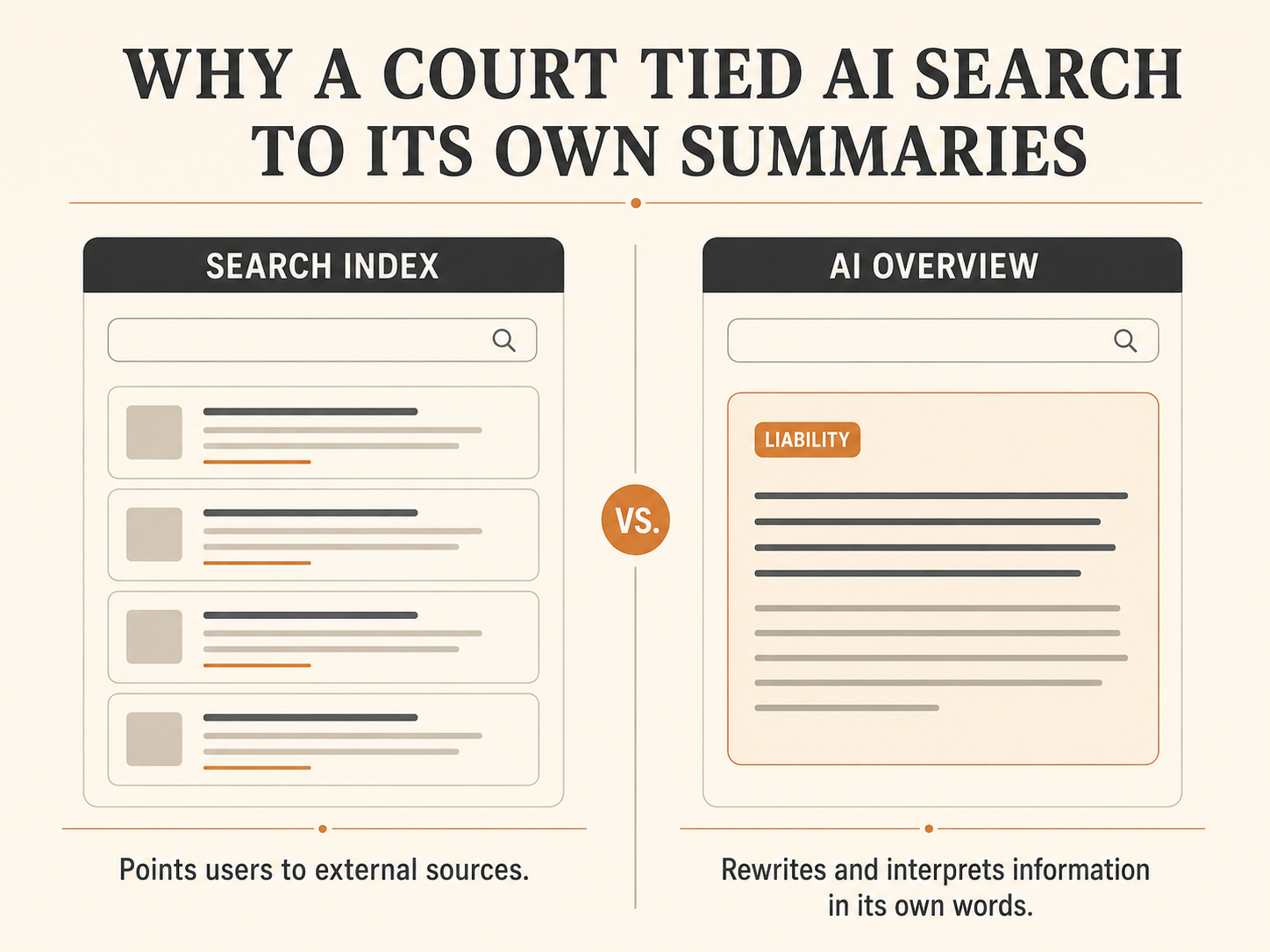
That shift matters because AI search does not behave like traditional search. A normal Google result points users toward a list of sources. An AI Overview does something more powerful. It reads, rewrites, summarizes, and gives users a direct answer in Google’s own interface.
That sounds useful when the answer is accurate.
But when the answer is wrong, it becomes a brand reputation problem.
A recent court decision in Germany shows why this matters.
A German Court Just Sent a Warning to AI Search Platforms
A regional court in Munich reportedly ruled that Google can be held responsible when its AI Overview makes false claims about a brand.
The issue involved two Munich publishing companies. Google’s AI Overview had connected them to scams and “subscription traps,” even though the cited sources did not support those claims.
That detail is important.
The problem was not simply that Google showed a bad search result. The problem was that Google’s AI layer created a summary that appeared to make its own judgment. It did not just send users to another website. It interpreted the information and presented the result as an answer.
That is where the legal and marketing issue begins.
Traditional search has always been built around links. Google could say it was indexing the web and helping users find information. But AI Overviews work differently. They do not only index information. They convert information into a finished response.
For brands, that changes the risk.
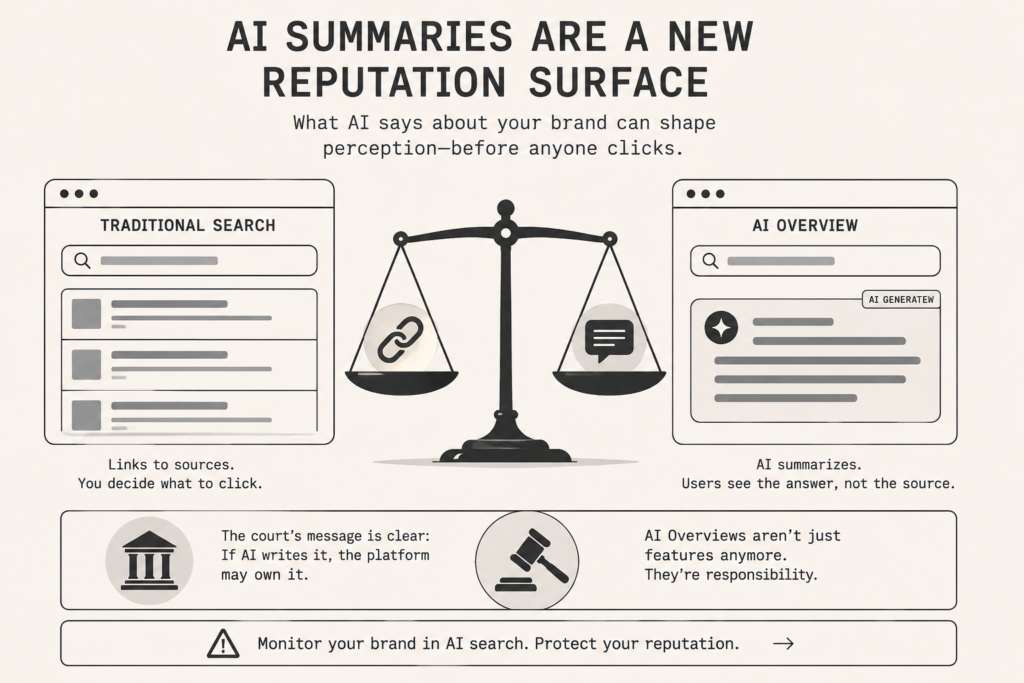
If an AI summary says something false about your business, many users may never click through to check the original sources. They may simply trust the answer because it appears directly inside Google.
That makes the AI summary itself a new reputation surface.
Why This Is Bigger Than a Legal Story
At first, this might look like a legal case about one court, one country, and one AI Overview.
But the bigger lesson is about how brand visibility is changing.
In the old search world, brands mainly cared about rankings. If your website ranked well, you had visibility. If negative content ranked above you, you had a reputation problem. If your competitors outranked you, you had an SEO problem.
Now, ranking is only part of the story.
AI search creates another layer between the user and the web. That layer decides what to summarize, what to ignore, what to connect, and what to present as the final answer.
That means brands are no longer competing only for search rankings. They are competing for how AI systems understand them.
This is a major shift for marketers.
A brand could have strong SEO, good website content, and positive press coverage, but still be misrepresented by an AI-generated summary. The user may never see the full source. They may only see the AI answer.
That creates a new question for every business:
What does AI believe about your brand?
AI Overviews Are Becoming a Reputation Surface
Every brand already has reputation surfaces.
Your website is one.
Your Google Business Profile is one.
Your reviews are one.
Your social media presence is one.
Your Reddit mentions, press articles, YouTube videos, and third-party listings are all part of the public picture.
Now AI Overviews need to be added to that list.
The difference is that brands cannot directly edit AI Overviews the way they can edit their website or Google Business Profile. The AI summary is generated from a mix of sources, signals, and context that the brand does not fully control.
That makes it harder to manage.
If your website has outdated information, you can update it.
If your landing page has weak copy, you can rewrite it.
If your ad campaign has poor messaging, you can pause it.
But if an AI Overview creates a false or misleading summary, the path to fixing it is less clear.
That is why this court decision matters. It suggests that when AI search platforms generate their own summaries, they may also carry responsibility for what those summaries say.
For brands, that creates both a risk and a possible protection.
Why Marketers Should Care
This is not only a legal issue. It is a marketing operations issue.
Marketers already monitor rankings, traffic, conversions, reviews, social mentions, and campaign performance. AI search monitoring may now need to become part of that same system.
If your brand appears in AI Overviews, you need to know what is being said.
Search your brand name.
Search your brand name with words like scam, lawsuit, complaints, pricing, refund, reviews, problems, and alternatives.
Do the same for your top products, services, executives, and competitors.
This is not paranoia. It is reputation hygiene.
The danger is not only that AI gets something wrong. The danger is that the wrong answer appears confident, polished, and official enough for users to believe it.
That is what makes AI-generated misinformation more serious than a random bad comment online.
A bad comment looks like a comment.
A bad AI summary can look like an answer.
The New Brand-Safety Checklist
Brands should start treating AI search as part of brand safety.
That means creating a simple monitoring process.
First, check how your brand appears in AI Overviews.
Second, document anything false, misleading, or unsupported.
Third, take screenshots with dates.
Fourth, compare the AI answer with the sources it claims to use.
Fifth, update your own website content if your public information is unclear, incomplete, or outdated.
Sixth, build stronger third-party signals through credible articles, profiles, case studies, and structured content.
This does not mean every company needs a massive AI search team. But it does mean companies need a habit.
The brands that ignore this will find out late.
The brands that monitor early will understand how AI systems are interpreting them before it becomes a larger reputation issue.
My Perspective:
From a marketing analytics and performance marketing perspective, this case shows that visibility is no longer just about clicks.
For a long time, marketers measured search mainly through rankings, impressions, CTR, and organic traffic. Those metrics still matter, but they do not fully explain what is happening in AI search.
If a user reads an AI Overview and never clicks, the brand may still be influenced positively or negatively.
That means the impact happens before the website visit.
This is where traditional analytics becomes weaker. GA4 may show fewer visits. Search Console may show impressions and clicks. But neither tool fully explains how AI summaries are shaping perception before the click.
That is why marketers need to think beyond traffic.
The question is not only, “Did the user visit our site?”
The better question is, “What did the user learn about us before deciding whether to click?”
That is the new search reality.
Final Takeaway:
The German court case is a signal of where AI search is heading.
AI Overviews are not just search features. They are becoming public-facing brand narratives. They summarize companies, judge context, and influence what users believe.
For brands, this creates a new responsibility: monitor how AI describes you.
For platforms, it creates a new pressure: if the AI writes the answer, the platform may not be able to hide behind the idea that it only showed users a link.
Search is no longer just about being found.
It is about being understood correctly.
And in an AI-driven search world, that may become one of the biggest brand-safety challenges marketers have to manage.
Reader Question:
If Google’s AI gives a false summary about a brand, who should be responsible the platform, the original sources, or the brand for not monitoring it early enough?